
A ranch house in Greensboro built in 1962 can hide asbestos in nine different spots, and most owners couldn’t name one of them. Houses simply got built that way before the late 1970s. Manufacturers packed the stuff into floor tile mastic, the paper wrap on furnace ducts and plenty in between. Selling a house with asbestos in North Carolina is legal, and it happens every week somewhere in the state. The legal part rarely trips anyone up. Lender rules do, along with disclosure forms and removal quotes with a comma in them.
Where Asbestos Commonly Hides in Older North Carolina Homes
For years I thought asbestos meant popcorn ceilings and nothing else. Lazy thinking on my part, it turned out.
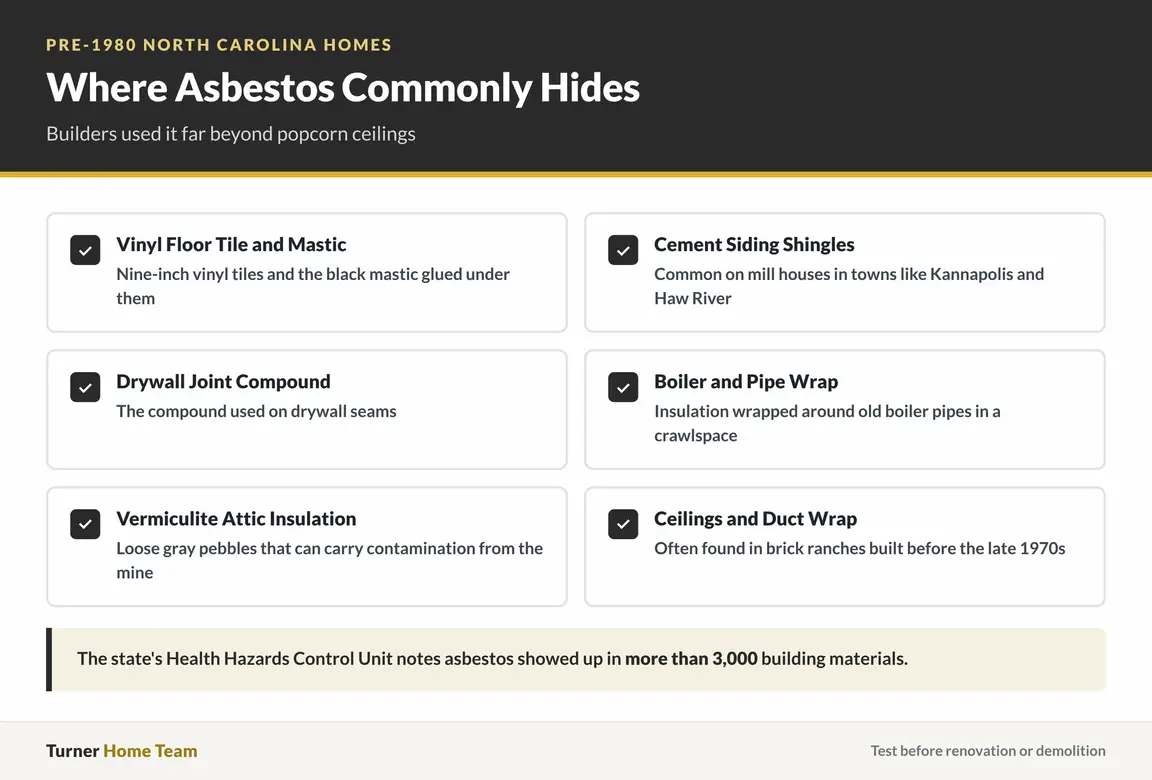
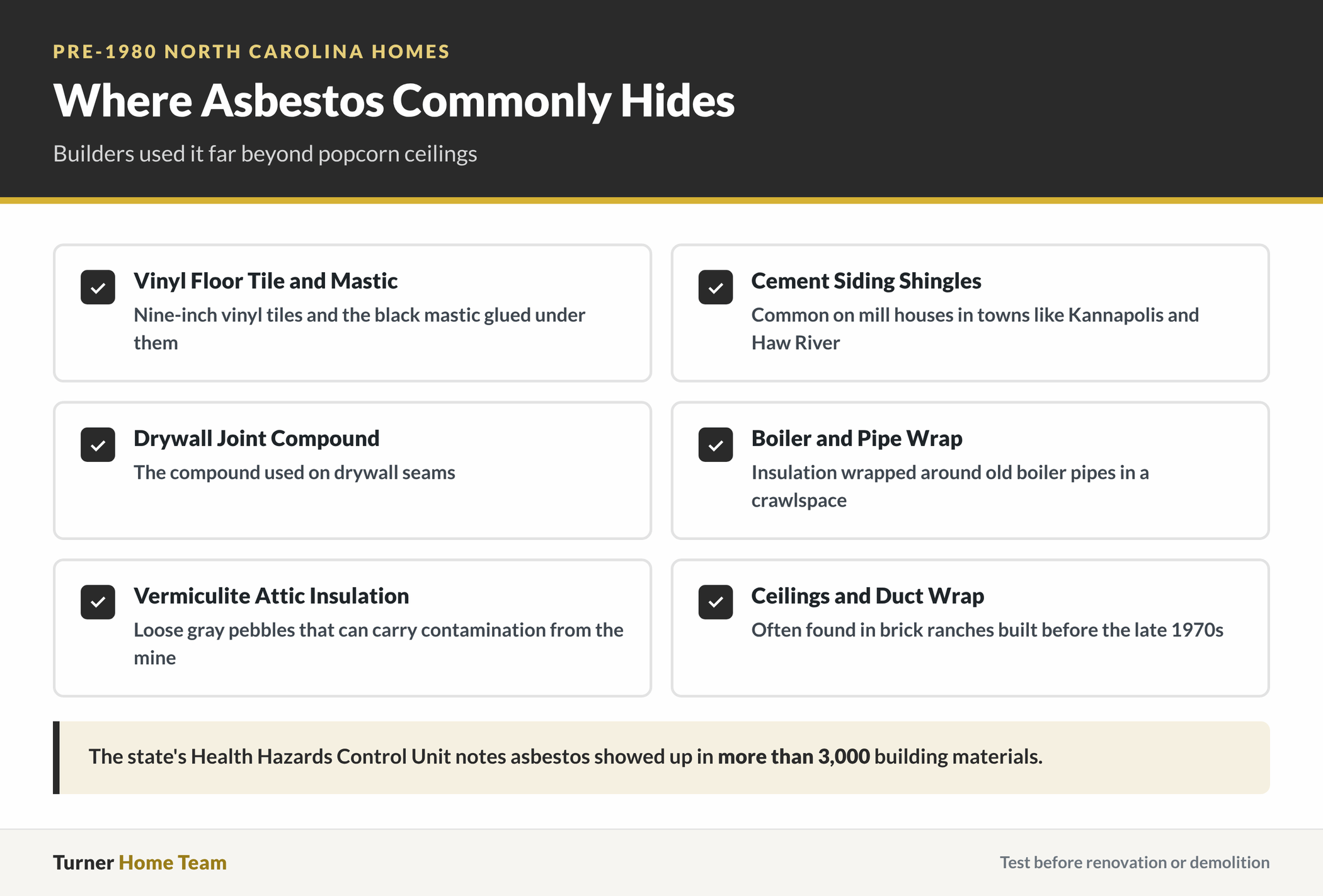
Builders put it almost everywhere. Walk through a typical pre-1980 North Carolina home and you might find asbestos in nine-inch vinyl floor tiles and the black mastic under them. It turns up in cement siding shingles and in the joint compound on drywall seams, too. Old boiler pipes in a crawlspace may wear it as wrap. The state’s own Health Hazards Control Unit says asbestos showed up in more than 3,000 different building materials. Attic insulation gets its own mention. Vermiculite looks like loose gray pebbles, almost like tiny popcorn kernels, and some of it carries asbestos contamination from the mine it came from.
Where the house sits changes what you’ll find. Mill houses in Kannapolis and Haw River tend to have asbestos siding and old linoleum. Brick ranches in Raleigh’s Longview Gardens or Charlotte’s Hidden Valley more often have asbestos in the ceilings and the duct wrap. Mountain cabins near Boone sometimes hide it in the stove board behind a woodstove.
Have you ever pulled up a corner of old kitchen flooring to see what’s underneath? In any house built before 1980, that’s where I’d look first.
A while back I worked with a family in Gastonia who were three months behind on the mortgage, with the auction date already on the calendar. You could feel the pressure the minute we sat down at their table. They’d gotten an asbestos quote for the floor tile in the kitchen and back hall, and that number stopped them cold. We bought the house with the tile right where it was and their father’s old boat trailer still parked in the garage.
The state recommends testing before any renovation or demolition starts. You can read more on the Health Hazards Control Unit’s asbestos page.
Friable Vs. Non-friable Asbestos: Why the Difference Matters
A $4,000 abatement quote can shrink to a few hundred dollars once an inspector walks through, looks at intact floor tile and says it’s fine where it sits. Plenty of sellers hear the word asbestos and picture a hazmat tent over the whole house. The inspector’s report usually tells a calmer story.
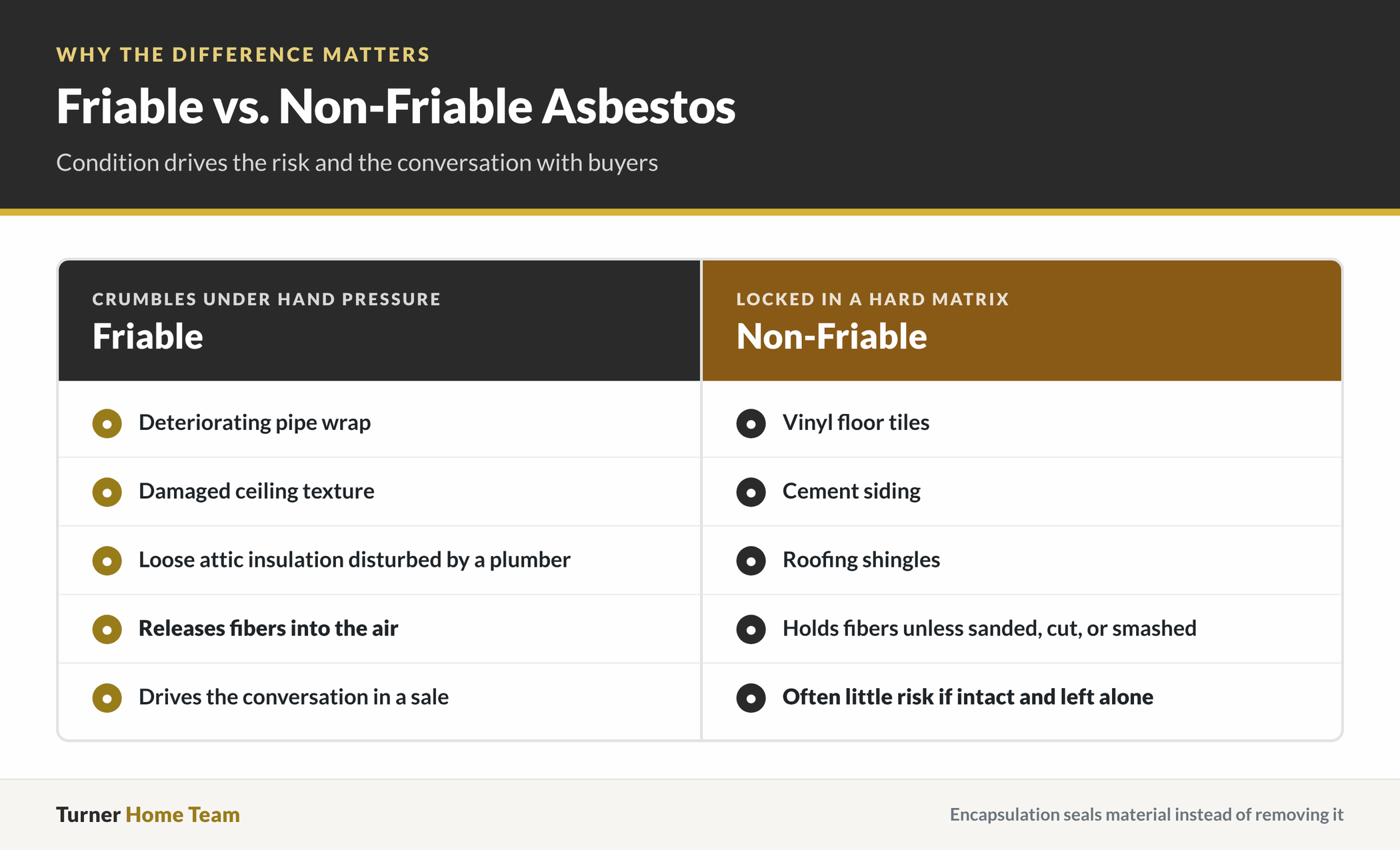
One word explains the gap between the fear and the finding: friable. If it crumbles under hand pressure, it’s friable asbestos. Picture deteriorating pipe wrap, damaged ceiling texture or loose attic insulation a plumber has stirred up. Non-friable asbestos stays locked inside a hard matrix. Vinyl floor tiles, cement siding and roofing shingles hold their fibers tight unless somebody sands, cuts or smashes them.
Friable material is what drives the conversation in a real estate transaction. It releases fibers into the air, and people breathe that air.
Non-friable asbestos in good condition often poses little health risk if left alone. Encapsulation seals the material behind a barrier instead of ripping it out, and local contractors use it all the time. I’d push back on the common advice to remove everything before listing. Disturbing intact asbestos can leave the property worse off, because the demolition is what creates the hazard.
Condition moves the price, though. A popcorn ceiling that took water damage from a roof leak during one of our coastal storms is a different animal from the same ceiling kept bone dry. Eastern North Carolina humidity keeps working on old materials year after year.
Buyers rarely sort out this distinction on their own. Their inspector writes “possible asbestos-containing material” in the report. The word asbestos alone does the damage, friable or not.
Can You Legally Sell a House with Asbestos in North Carolina?
A widow in Wilmington called me last year sure she was committing a crime by listing her 1955 bungalow. Her neighbor had told her the state wouldn’t let her sell until every scrap of asbestos was gone.
She was wrong, and so was the neighbor. No North Carolina statute bars you from selling a home that contains asbestos. Nothing forces removal before a residential transfer, no state inspection happens at closing, and you don’t need a certificate. Asbestos isn’t banned outright in homes, either. Rules govern how it’s handled during renovation or demolition.
Those rules kick in when material gets disturbed, not when a deed changes hands.
North Carolina does draw a firm line around the work itself. Only properly certified abatement professionals may handle regulated quantities of asbestos-containing material. The state’s program also issues permits for asbestos removal projects and demolition notifications. So you’re free to sell, but you can’t hire your brother-in-law with a shop vac to strip a ceiling before the open house.
Selling as-is is a legitimate strategy, not a confession. I’ve bought plenty of North Carolina properties with asbestos siding still on the walls, and those sales closed like any other. What matters is that the buyer knows what they’re getting and signs off on it.
Cash buyers and investors pick up these properties all the time, since they don’t answer to an underwriter who’s never seen the house.
What North Carolina Law Requires You to Disclose About Asbestos
Do you have to go looking for asbestos before you sell?
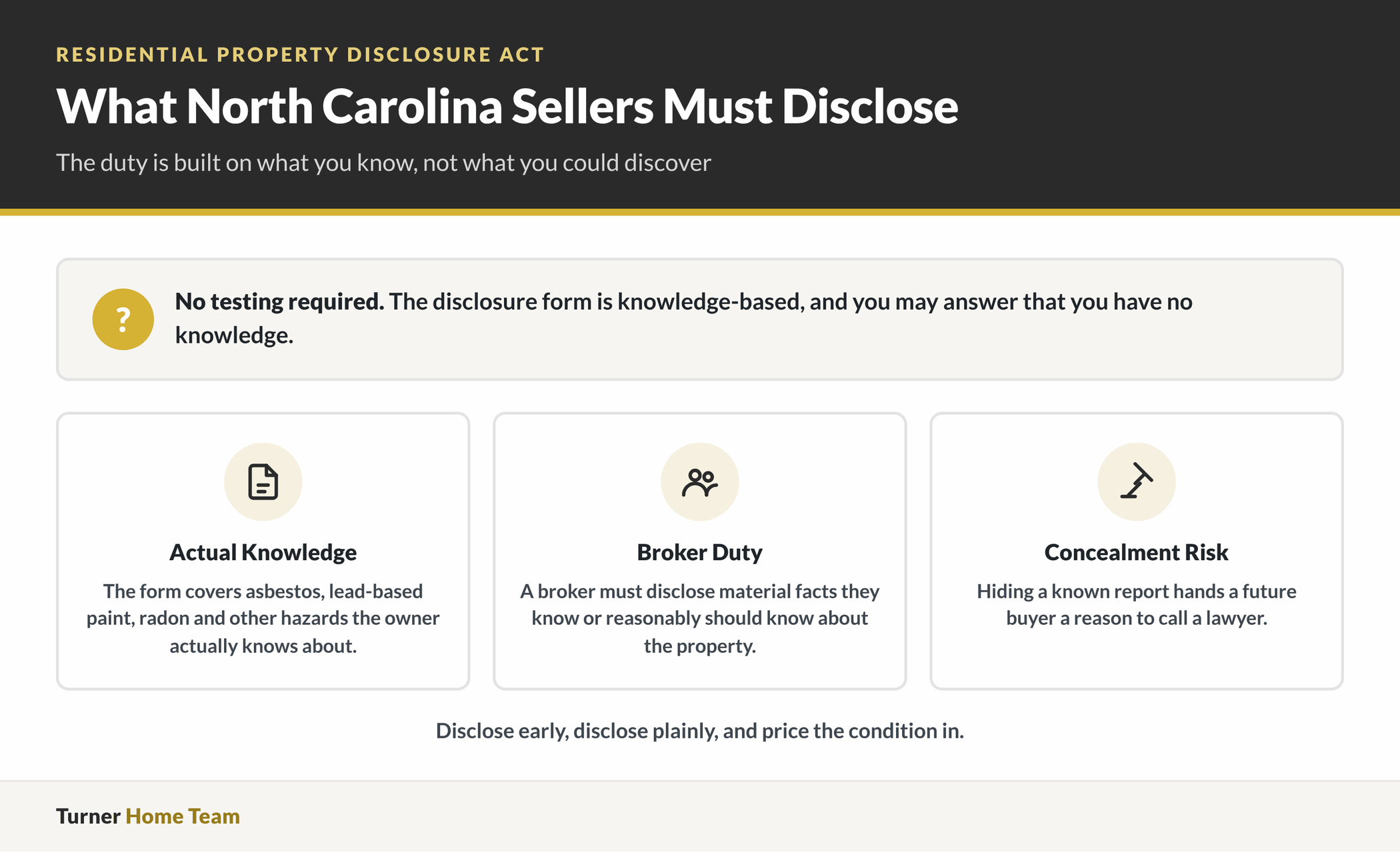
No. The state’s disclosure duty is built on what you know, not what you could discover. North Carolina’s Residential Property Disclosure Act requires owners to give a buyer a disclosure statement covering anything they have actual knowledge of. Its form names lead-based paint, asbestos and radon gas. Methane gas, underground storage tanks and other hazardous or toxic material are on it too. The statute text is on the North Carolina General Assembly’s site.
You don’t have to test before filling out the disclosure. The form asks what you know, and it isn’t a certificate saying the house was tested. That surprises people. Answering that you have no knowledge is allowed.
Lying is where sellers get burned. Say you’ve got an old inspection report in a drawer showing asbestos in the attic insulation. Check the “no representation” box hoping nobody notices, and you’ve handed a future buyer a reason to call a lawyer. Lawsuits over hidden conditions get expensive fast, and the fight usually costs more than the abatement would have.
Brokers carry their own duty here. A real estate broker on either side must disclose to the buyer any material facts they know or reasonably should know about the property. Ask your agent to keep quiet about asbestos and you’re asking them to risk their license. They’ll say no.
My advice cuts against what most sellers believe. Disclose early, disclose plainly, and price the house with the condition built in. Buyers who find out on day one negotiate. The ones who find out on day twenty walk.
How Asbestos Problems Can Derail a North Carolina Home Sale
North Carolina homes sat on the market a median of 71 days in October 2026, according to Realtor.com data tracked by the St. Louis Fed. An asbestos surprise mid-contract can wipe out every one of those days if the sale falls apart and you have to relist.
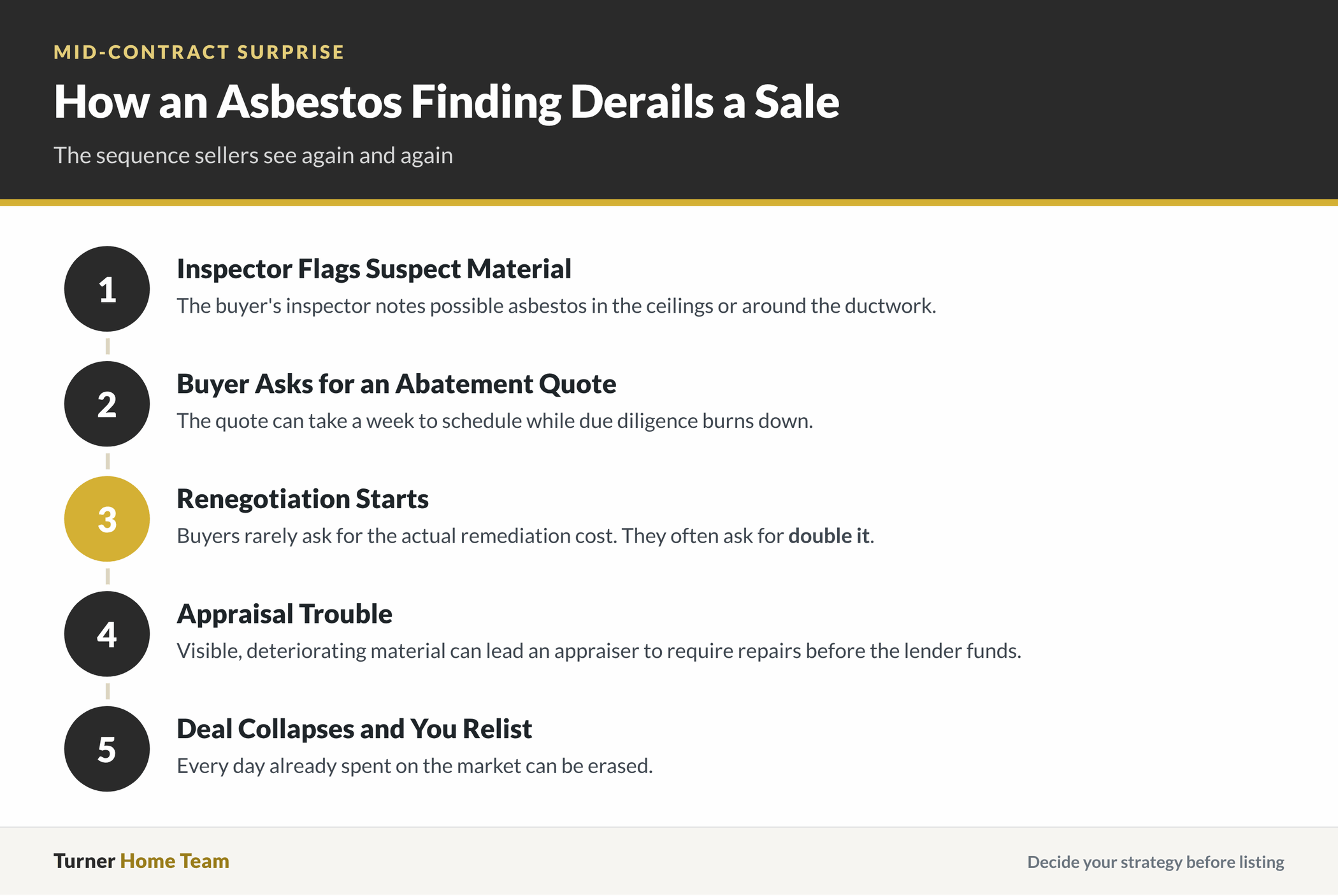
This pattern repeats itself. The buyer’s inspector flags suspect material in the ceilings or around the ductwork, and the buyer gets nervous. Their agent recommends an abatement quote. Scheduling it can take a week, and the due diligence period keeps burning down while everyone waits.
Then the renegotiation starts. Buyers rarely ask for the real remediation cost. Instead they ask for double it, because the unknown scares them more than any number.
Appraisal trouble follows when the asbestos is visible and deteriorating. An appraiser who notes damaged material may require repairs before the lender funds, and the loan stops cold until they’re done.
A soft market makes all of this worse. In Wake County, prices for the three months ending October 2026 were down 4.1 percent year over year, at a $459K median, with homes selling after about 50 days. When buyers have choices, they won’t fight for a house with a hazardous material question hanging over it. Over in Durham, Zillow put the typical home value at about $389,600 in August 2026, down 3.4 percent from a year earlier. Even in that slightly steadier market, I watch asbestos findings cost sellers their strongest offer.
Sellers who get through this cleanly picked a strategy before they listed. Teams like Turner Home Team buy North Carolina properties with the asbestos already disclosed. Nobody gets surprised halfway through the contract.
Why Can’t FHA and VA Buyers Close on an Asbestos Home As-Is?
Picture us at your kitchen table with a pot of coffee. The plain version is that your buyer pool shrinks the second a government-backed loan enters the picture.
FHA and VA loans come with minimum property standards. Appraisers on those files look for hazards that threaten the health and safety of the people living there, and deteriorating asbestos lands right in that category. Intact non-friable material usually passes without a comment. Crumbling pipe insulation in a basement won’t.
When an appraiser calls it out, the repair has to happen before closing. Not after. Either the seller pays for abatement up front, or the buyer walks away.
Who gets hurt by this? First-time buyers in North Carolina lean hard on FHA financing. Veterans using VA benefits make up a big share of the market around Fayetteville, Jacksonville and Havelock. Lose those buyers and you’ve lost a real slice of demand in exactly the neighborhoods where the older houses sit.
Conventional lenders have more room to work with, though underwriters still get skittish when an appraisal mentions asbestos. I’ve seen conventional loans held up until an accredited professional signed a clearance letter.
Cash changes the equation completely. There’s no appraiser, no underwriter and no minimum property standard to clear. That’s why investors buy so many of these North Carolina properties. To them, asbestos is a line item in a renovation budget, not a pass-fail condition on a loan file.
Think about your own timeline for a minute. Could your situation absorb a sixty-day financing attempt that might fail at the appraisal?
What Does Asbestos Removal Cost North Carolina Homeowners?
Guess wrong on this number and you’ll price your house around a repair budget that doesn’t exist, then give the difference back in negotiation anyway.
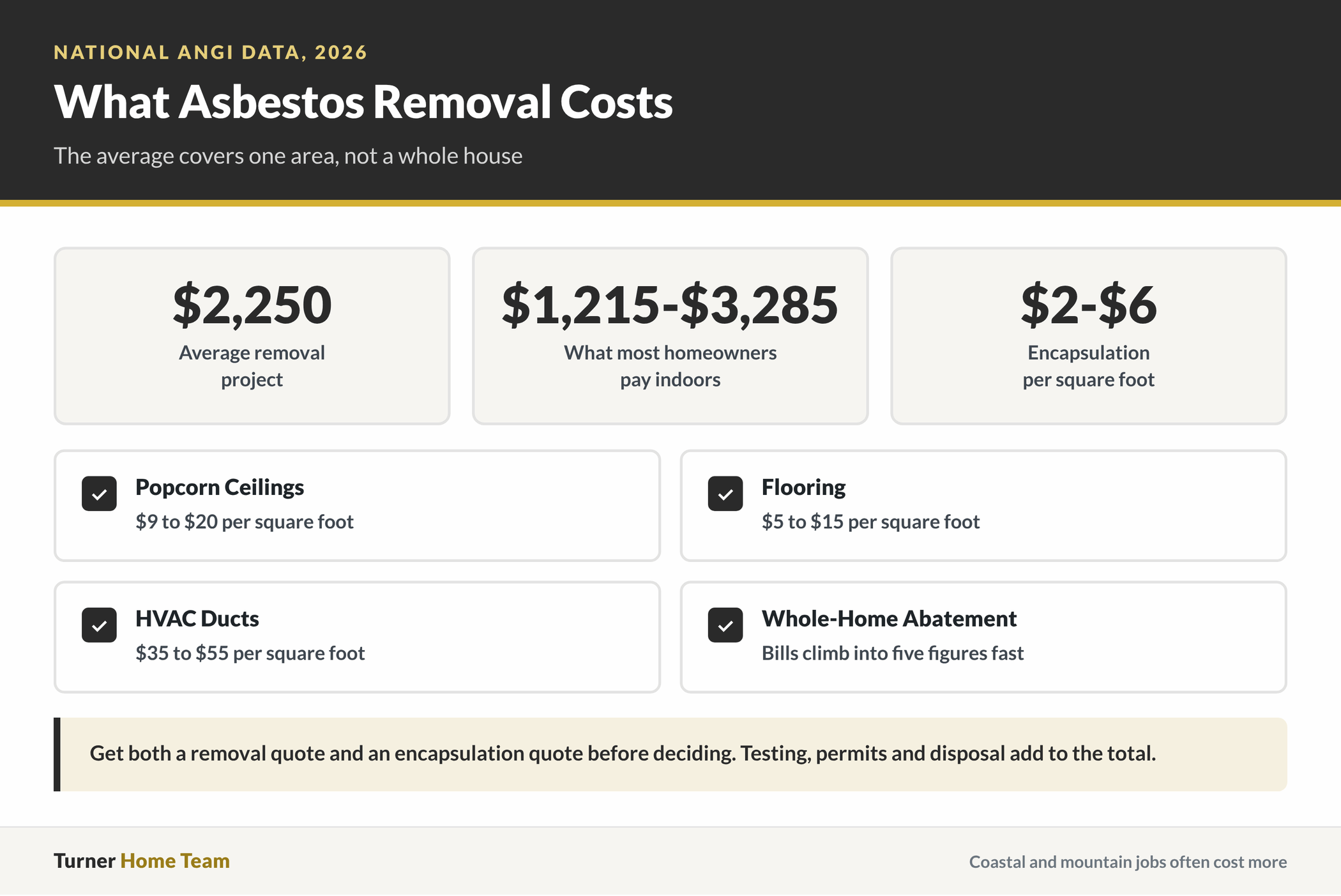
Nationally, Angi data puts the average asbestos removal project at $2,250 for 2026. Most homeowners pay between $1,215 and $3,285 for an indoor job. Keep in mind the average covers one area, not a whole house. Popcorn ceilings run $9 to $20 per square foot, flooring runs $5 to $15, and HVAC ducts come in at $35 to $55. Encapsulating costs $2 to $6 per square foot instead, which is why I tell sellers to get both quotes before deciding.
Whole-home abatement is a different conversation, and those bills climb into five figures fast.
Labor in the Piedmont Triad and the Triangle tends to price near the middle of national ranges. Coastal and mountain jobs often cost more, since fewer accredited crews work out there. Testing, permits and disposal come on top of the removal itself.
Not just anyone can do this work. Under North Carolina’s Asbestos Hazard Management Program, trained individuals have to pass an EPA-approved course and exam to become accredited, then get an accreditation number from the Health Hazards Control Unit. Keeping it means taking an approved refresher course within twelve months of the initial course or the last refresher. You’ll find the details on the state’s asbestos FAQ page.
An heir in Kernersville reached out after nearly a year of quietly covering two mortgages, hers and her late mother’s, without telling anyone in the family. The 1958 house had asbestos tile all through the den and a detached garage full of her father’s woodworking tools. She just wanted the second payment to stop. We closed without her ever touching that floor.
Frequently Asked Questions
How Much Does Asbestos Testing Cost Before a Sale?
Testing a home for asbestos usually costs a few hundred dollars, and a lab takes several days to turn it around. You own that report once you pay for it. Many North Carolina sellers skip testing and disclose the condition as unknown, which the law allows. If you do test and it comes back positive, you have actual knowledge, and the disclosure duty comes with it.
Can a House with Asbestos Be Sold in North Carolina?
Yes, and it happens all the time across the state. No statute forces removal before a transfer, and no state agency signs off on your closing. Your job is honesty about what you know. Finding a buyer whose financing won’t choke on the condition is the practical challenge.
How Long Does It Take to Become Certified to Remove Asbestos?
The initial training course runs anywhere from a day for basic worker roles to about a week for more specialized positions. Passing the exam is only step one. After that, you send the state’s Health Hazards Control Unit an application with proof of training and a fee before you’re accredited to work. Annual refresher training keeps that accreditation alive, and letting it lapse too long sends you back to the initial course.
Is It Safe to Live in a House with Asbestos Floor Tiles?
Generally yes, as long as the tiles are intact and nobody’s sanding, drilling or breaking them up. Non-friable asbestos locked in vinyl doesn’t shed fibers into the air the way damaged friable material does. Trouble starts during renovations, so North Carolina homeowners should test before pulling up old flooring, not after.
Should I Remove Asbestos Before Listing My North Carolina Home?
It comes down to your buyer pool and your cash position. If you’re aiming at FHA or VA buyers and the asbestos is deteriorating, abatement may be the only way to reach closing. When time or money is short, selling as-is to a cash buyer often nets more than borrowing against the house for a remediation you’ll never fully get back in price.
What Happens If I Don’t Disclose Asbestos I Knew About?
A buyer who finds concealed asbestos after closing can take legal action against you, and those cases turn on what you knew and when. The disclosure form is a signed document, and courts take that signature seriously. Checking a box you know is false in a North Carolina sale isn’t worth the few thousand dollars it might save on price.
Older Homes in the Raleigh-Durham Area
Plenty of houses around the Triangle went up before asbestos fell out of use. Zillow put the typical Raleigh home value at about $428,700 at the end of August 2026, 1.7% lower than a year earlier. In a softer market, buyers lean harder on anything an inspector flags.
If your house is in the Triangle, our page for Raleigh-Durham sellers explains how we work there.
If you’re staring at an asbestos problem and can’t decide whether to fix it, disclose it or just be done with the house, we’re glad to talk it through. We buy houses across North Carolina in whatever condition they’re in, asbestos included. You’ll get a straight answer about your options, even if selling to us isn’t one of them.
Talk Through Your Asbestos Questions With Us
Not sure whether to test, disclose, or sell the house as it sits? You can contact Turner Home Team and we’ll walk through what fits your situation. If that’s easier, just fill out the form below.