


A fire doesn’t check the closing calendar. Neither does a windstorm, a burst supply line under the sink, or a kid who cuts across your backyard and trips on a loose paver. Those risks stay with you until the deed changes hands. The homeowners insurance policy you’ve been quietly paying for is the only thing standing between you and a bill you can’t absorb. Plenty of sellers see that policy as a line item to kill the moment they accept an offer, and that instinct costs people real money.
Selling takes longer right now than it did a year ago, which stretches the window where all of this matters. The median existing-home price sat at $416,700 in October 2026, up 0.4% from a year earlier. Homes spent a median of 35 days on the market, up from 33 days in September. That’s thirty-five days to a contract, then another month or more to closing.
Do You Still Need Homeowners Insurance When Selling Your House?
Yes, and it isn’t close. You own the house until the closing documents are signed and the deed is recorded, so every risk the property carries belongs to you until that moment. Homeowners insurance is what soaks it up.
Your mortgage company gets a say here too. If the property has a mortgage, the loan documents almost certainly require continuous coverage. Let the policy lapse and the servicer can force-place a policy on you that protects the lender’s interest, not yours, usually at a price that stings.
Sellers tend to forget the liability half. Showings put strangers in your house, often while you’re out. An inspector climbs into the attic. A buyer’s toddler yanks on a loose bannister. The liability portion of your homeowners insurance covers those claims, and that protection disappears the day the policy does.
Early last year I worked with three siblings in Goldsboro. They’d inherited their mother’s ranch house. For close to a year they’d been quietly covering two mortgages, theirs and hers, while the listing sat. They hadn’t touched the homeowners insurance, and that turned out to be the one smart thing in the whole mess. In February the water heater in the garage let go, right next to their late father’s woodworking equipment. That claim paid.
Should you keep paying for a house you’ve already moved on from emotionally? I think so. The premium is small next to what one uncovered loss does to a sale that’s already under contract.
How Long Should Homeowners Insurance Stay Active During a Home Sale?
A seller named Dana once asked her agent why she still needed coverage after signing papers on a house that was already sold. Coverage should run through the recording of the deed, not through the signing of the papers. Those two events can land a day apart or several, depending on your state and your title company. Ask yours which one ends your exposure.
Keep the policy active until the money hits your account and the transfer is recorded. That’s the rule I’d give anyone. Cancel on the morning of closing and you’ve opened a gap that’s very hard to explain if something happens between 9 a.m. and the afternoon recording.
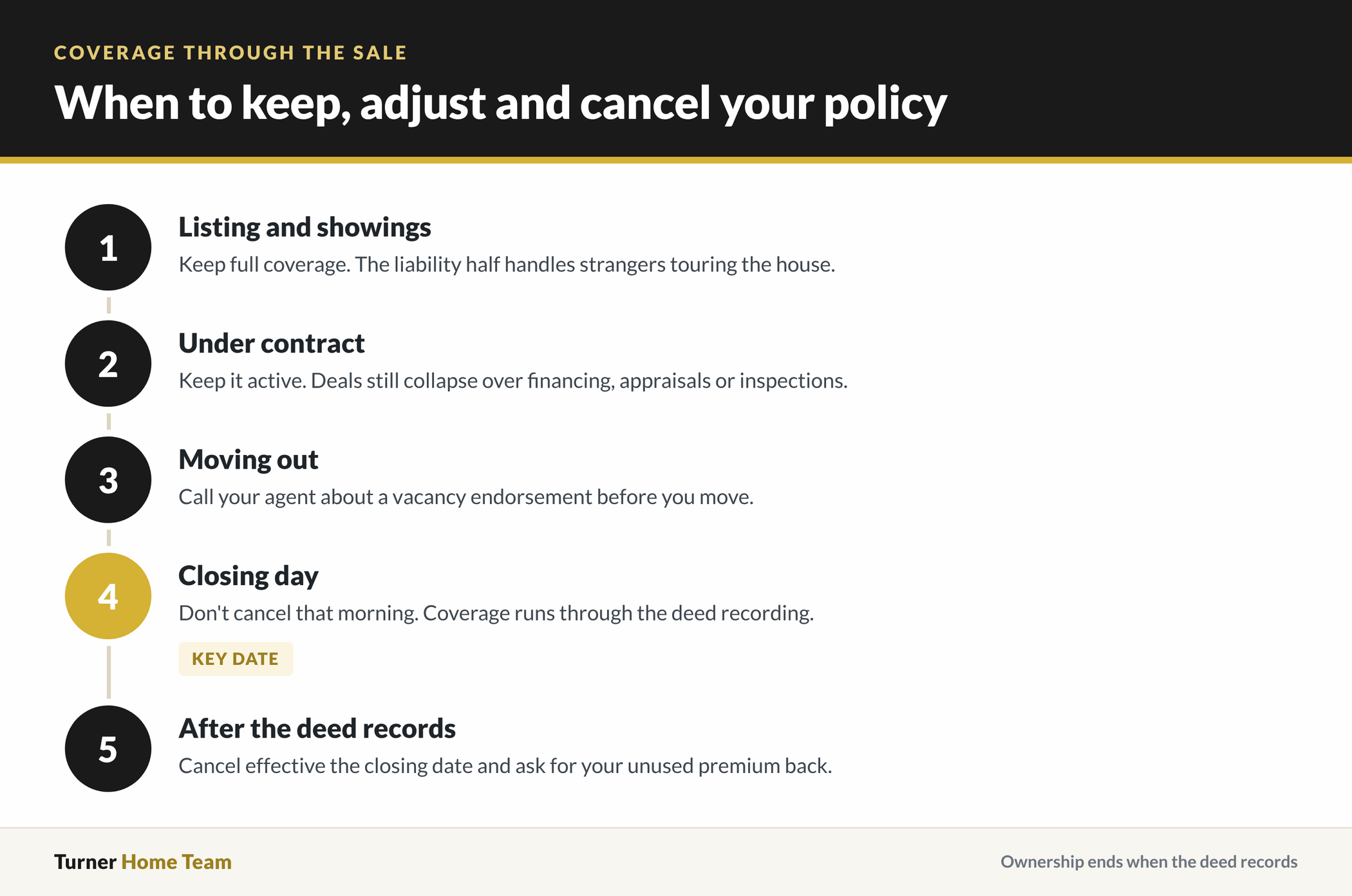
Contracts collapse for all sorts of reasons: financing dies in underwriting, an appraisal comes in low, or an inspection turns up a foundation issue and the buyer walks. Cancel your homeowners insurance ahead of a closing that never happens and you’re stuck reapplying. Insurers in many markets are pickier than they were five years ago.
What about the stretch after closing? You can’t make a claim on a house you no longer own. Your interest ends with your ownership, and the policy ends with it.
One more timing wrinkle. If you’re buying a new place, that new policy has to be bound before its closing, not after, because lenders won’t fund without proof of coverage. I keep seeing sellers line up the sale beautifully, then scramble for homeowners insurance on the buying side with three days to spare. That’s how people end up overpaying for a policy they never shopped.
Does Homeowners Insurance Cover a Vacant House During the Selling Process?
I’ll put this the way I would over a cup of coffee: the day you move out, your policy starts working against you. Standard homeowners policies restrict or void coverage after 30 to 60 consecutive days of vacancy, so the exact threshold varies by insurer and policy form. Once that clock runs out, the vacancy clause can drop coverage for vandalism, theft, water damage and broken glass, and your insurer may cancel or decline to renew you.
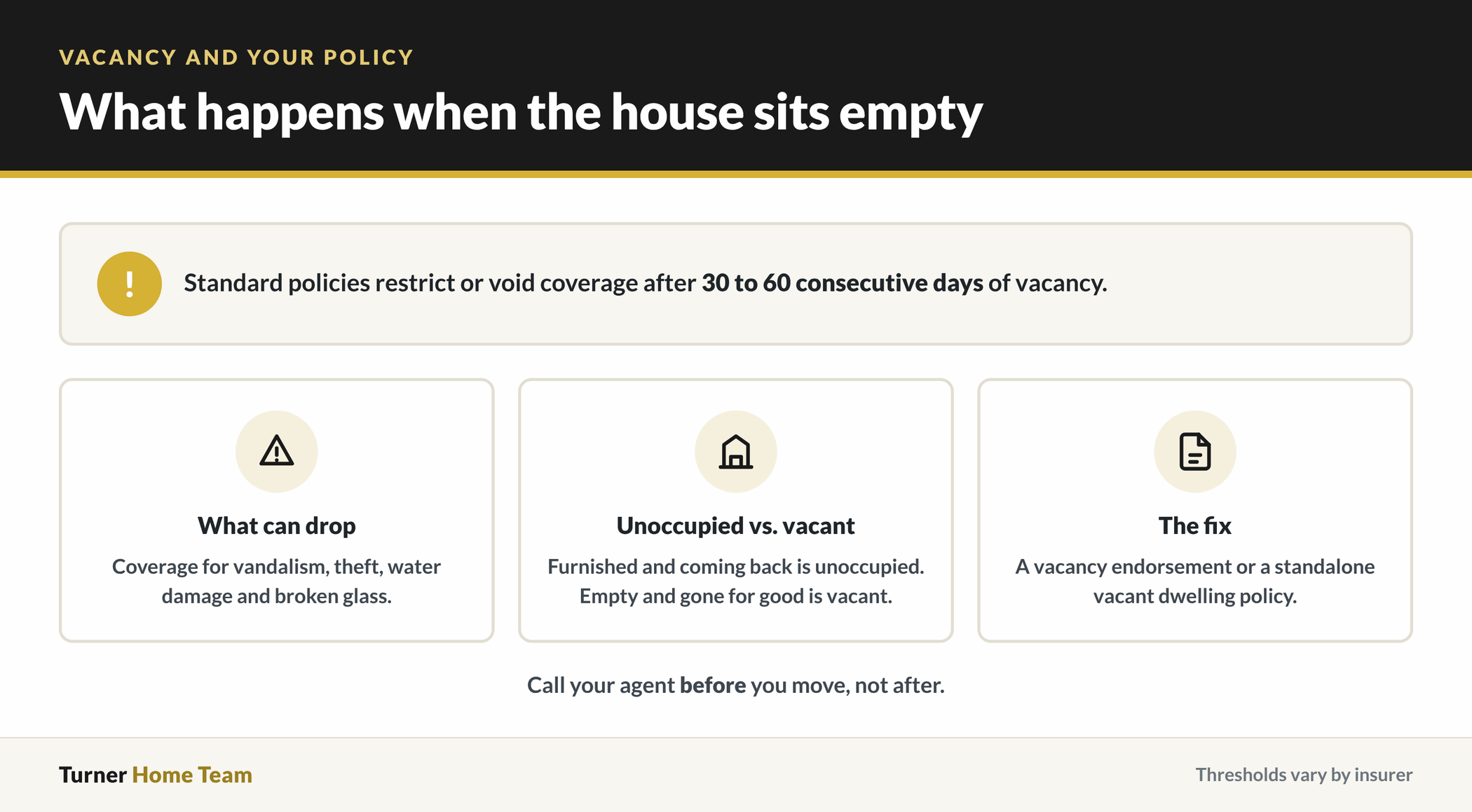
Vacant and unoccupied mean different things in a policy. A furnished home you plan to come back to is unoccupied; an empty home you’ve left for good is vacant. Claims turn on that difference.
Next to the alternative, the fix is simple and cheap. A vacancy endorsement stretches your existing policy’s protection for a set period past the standard window, and a standalone vacant dwelling policy covers longer stretches. Call your agent before you move, not after.
This matters more than it used to, because the gap between moving out and closing keeps growing. Inventory climbed to 1.59 million homes and a 5.1-month supply in October 2026. A house that needs five weeks to get an offer and another six to close has sat empty well past most vacancy thresholds.
Some sellers in this spot decide the empty-house math has stopped working. If you’re staring at months of premiums, utilities, and lawn care on a house nobody lives in, pricing out a direct sale makes sense. The folks at Turner Home Team buy in as-is condition and close on a date you pick, which shrinks the vacancy window instead of stretching it.
How Much Does Homeowners Insurance Cost While Your House Is Listed?
“I’m already bleeding money on this house, why add another bill?” Fair objection. Honestly, the bill isn’t new. You’re already paying it, and listing the house doesn’t change the premium by itself.
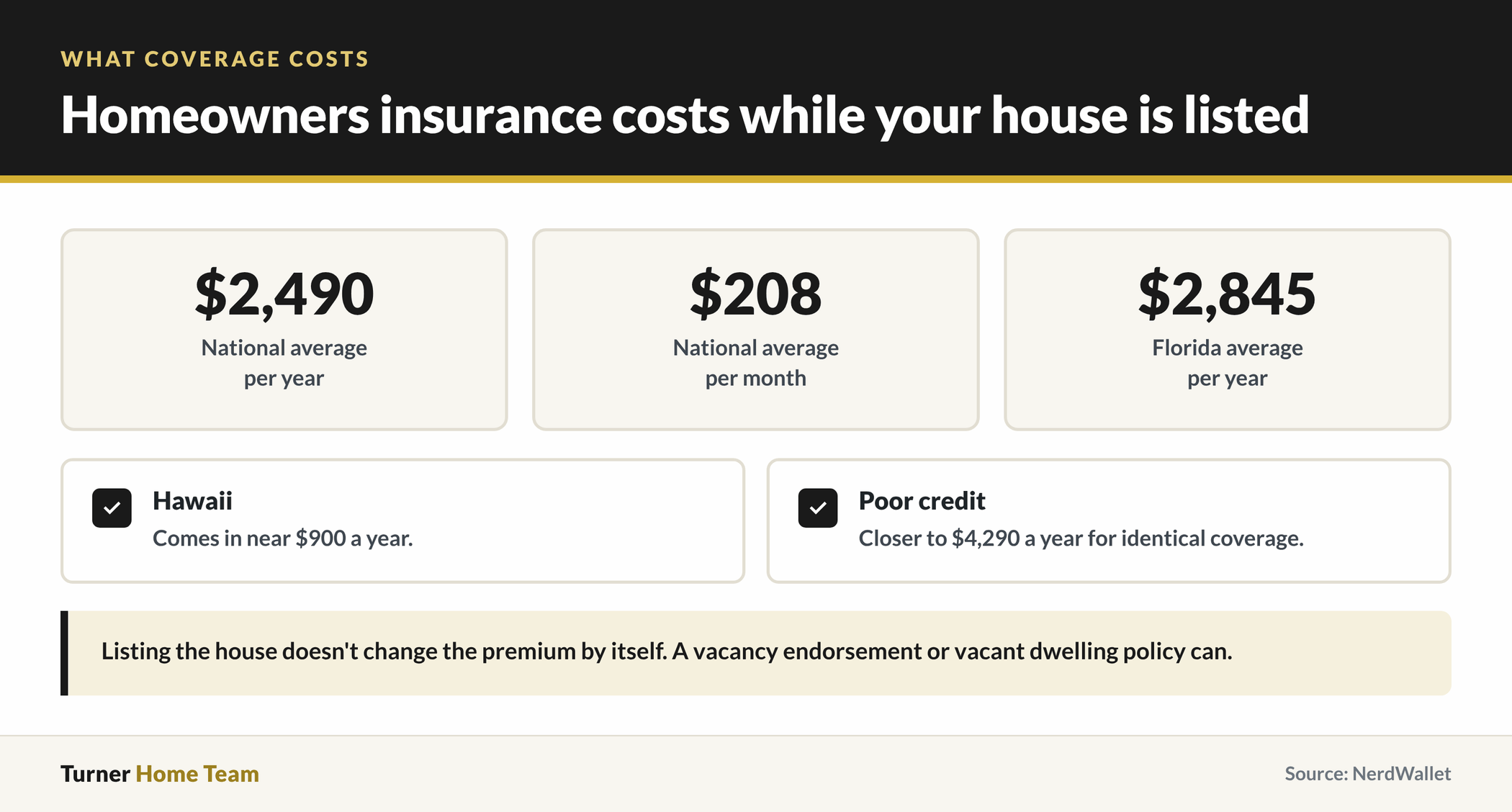
Nationally, home insurance averages $2,490 a year, roughly $208 a month, according to NerdWallet’s analysis. Your number swings hard by state. Florida averages $2,845 a year and Hawaii comes in near $900, so treat any national figure as a starting point and nothing more.
Two things can push your cost up during a sale. A vacancy endorsement carries a surcharge. And if your carrier reclassifies the property as vacant dwelling risk, the specialty policy usually prices above a standard one, since nobody’s around to catch a leak at 2 a.m.
Shopping carriers in the middle of a sale is usually wasted energy, and I’ll say so plainly even though “shop around” is the standard advice everywhere. You’re months from giving up the property. Switching homeowners insurance now means new underwriting, maybe an inspection, and a refund calculation on the old policy.
Credit drives pricing more than most sellers would guess. NerdWallet found homeowners with good credit pay much less each year than those with poor credit, who pay closer to $4,290 for identical coverage. That matters most for the policy on your next house, not this one.
Can You Cancel Homeowners Insurance Before the Sale Is Final?
What happens if you drop coverage too soon? Picture this. A seller cancels her policy the Monday before a Thursday closing to save a few weeks of premium. Wednesday night a storm drops a limb through the roof, and the buyer’s lender won’t fund until the roof is repaired.
Technically you can cancel any time. You just shouldn’t, and during the loan’s term your mortgage servicer usually won’t let you anyway. Cancellation before recording is one of the few truly unforced errors in a home sale.
Sellers who try it usually have one of two reasons: cash is tight, or they assume the buyer’s new policy somehow covers the gap. It doesn’t. The buyer’s homeowners insurance binds at their closing and protects their interest, not yours. It won’t pay for damage that happened while you held title.
What about smaller changes short of canceling? Those are fine. Raising a deductible, dropping a scheduled jewelry rider once the jewelry has moved, trimming personal property coverage after the house is empty: your agent can handle those without opening a coverage gap.
Most carriers issue a pro-rata refund for unused premium when you cancel after a sale, so the extra weeks cost you only those weeks. Playing it safe doesn’t mean donating a full year to the insurer. Before you sign anything, ask your carrier whether they use short-rate or pro-rata cancellation.
Have you checked whether your policy auto-renews during your expected closing window? If renewal hits first, you’ll want to know before the bill shows up.
What Happens to Your Homeowners Insurance Policy at Closing?
Skip this step and you’ll keep paying for a house somebody else owns. It happens a lot, especially when premiums are escrowed and the payment is invisible.
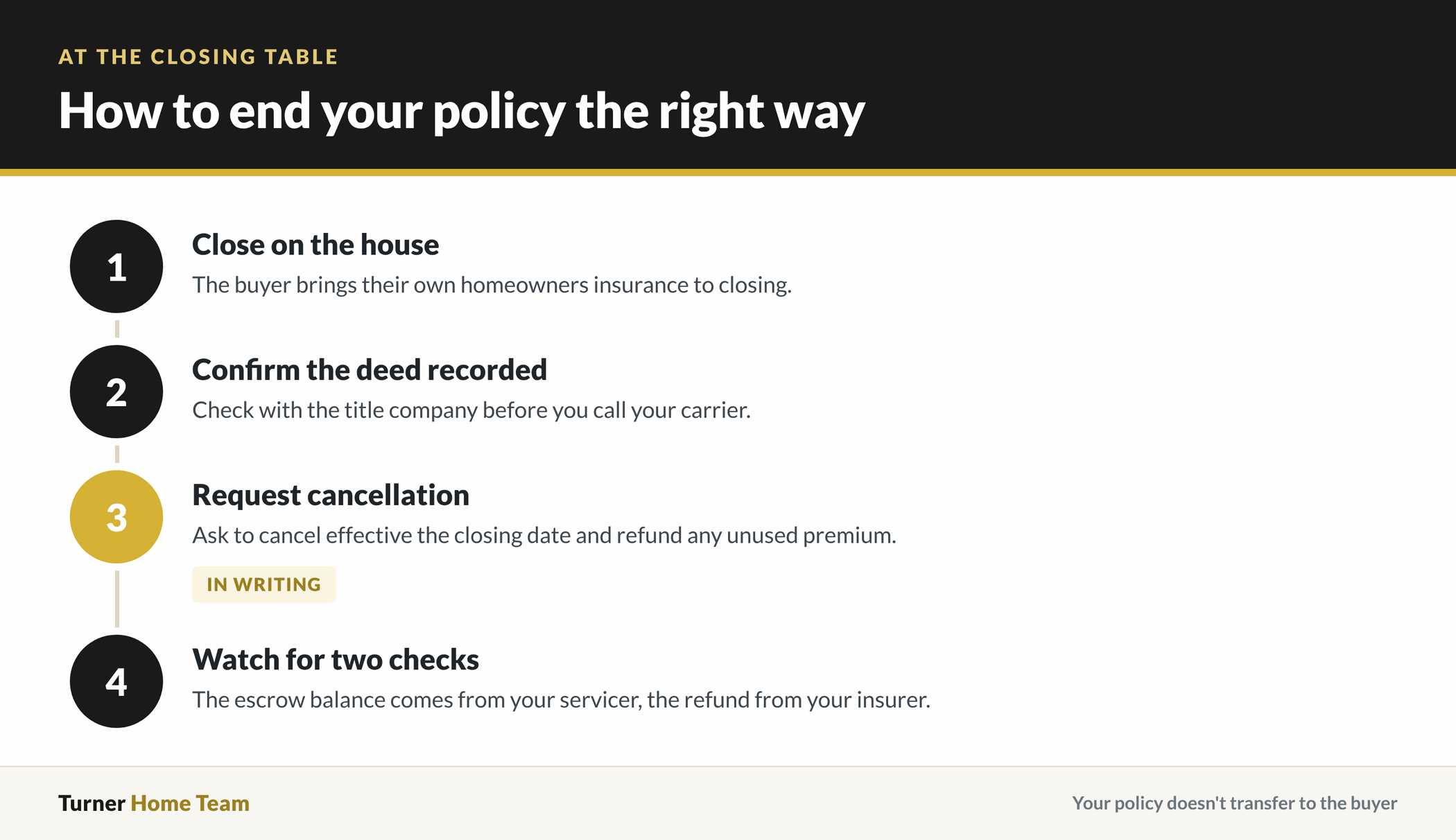
Your policy doesn’t transfer to the buyer. Homeowners insurance follows the person, not the property, and the buyer brings their own coverage to the closing table. Yours ends when you ask for it to end, so the request has to happen.
My sequence goes like this. Close on the house. Confirm with the title company that the deed is recorded. Then call or email your carrier with the closing date, and ask them to cancel effective that date and issue the refund.
Escrow adds another wrinkle. If your lender collected insurance premiums monthly, the payoff at closing shuts that account down, and the servicer mails your leftover escrow balance separately from any insurance refund. Two checks, two timelines, two chances for a wire to hit a stale address. Give the lender and the carrier your forwarding address in writing.
Hang on to your declarations page and your cancellation confirmation. A dispute over a loss from before closing can surface later, and proof of what your homeowners insurance covered on the day of the loss is the only thing that settles it.
Email confirmations are your friend here. Phone cancellations vanish; emails don’t.
What Does the Buyer Need to Know About Homeowners Insurance?
For years I figured insurability was the buyer’s problem and none of my business as a seller. Wrong. A buyer who can’t get affordable homeowners insurance on your house can’t close on your house, and that failure lands right in your lap.
Underwriting checks the roof age, the electrical panel, the water heater, the plumbing material, and your claims history on the property. Past water claims can make a house harder to insure even after repairs. On older homes, that’s the most common insurance snag I run into.
Buyers should bind coverage well before closing, not on the day. Carriers in wildfire and coastal regions may turn a property down flat, and learning that three days before funding turns a routine closing into a crisis.
Your part is simple. Be honest about the roof’s age, share repair receipts, and hand over records of past claims if asked. With the average 30-year fixed rate at 7.11% as of November 12, 2026, buyers are already stretched on payment, and a surprise premium quote can tip a marginal approval over the edge.
A couple in Asheville, North Carolina came to us after a contractor’s estimate on their galley kitchen came back higher than what the kitchen would add to the sale price. Their buyer’s carrier had also flagged a fifty-year-old panel in the basement. Between the two, they faced repairs with no guarantee the next buyer’s homeowners insurance would clear the house either. They sold as-is on a Friday and skipped the whole chain.
If repairs and insurability are tangling up your sale, Turner Home Team is a sensible place to get a second opinion before you spend money.
How Do You Get an Instant Homeowners Insurance Quote for a New Home?
Waiting days for a callback just to hear a ballpark figure wastes your time. You can get a real number today without that hassle.
Most national carriers and comparison sites will quote homeowners insurance online in a few minutes from the property address, square footage, year built, roof age, and your claims history. That quote stays an estimate until underwriting checks the details, so expect it to move a little.
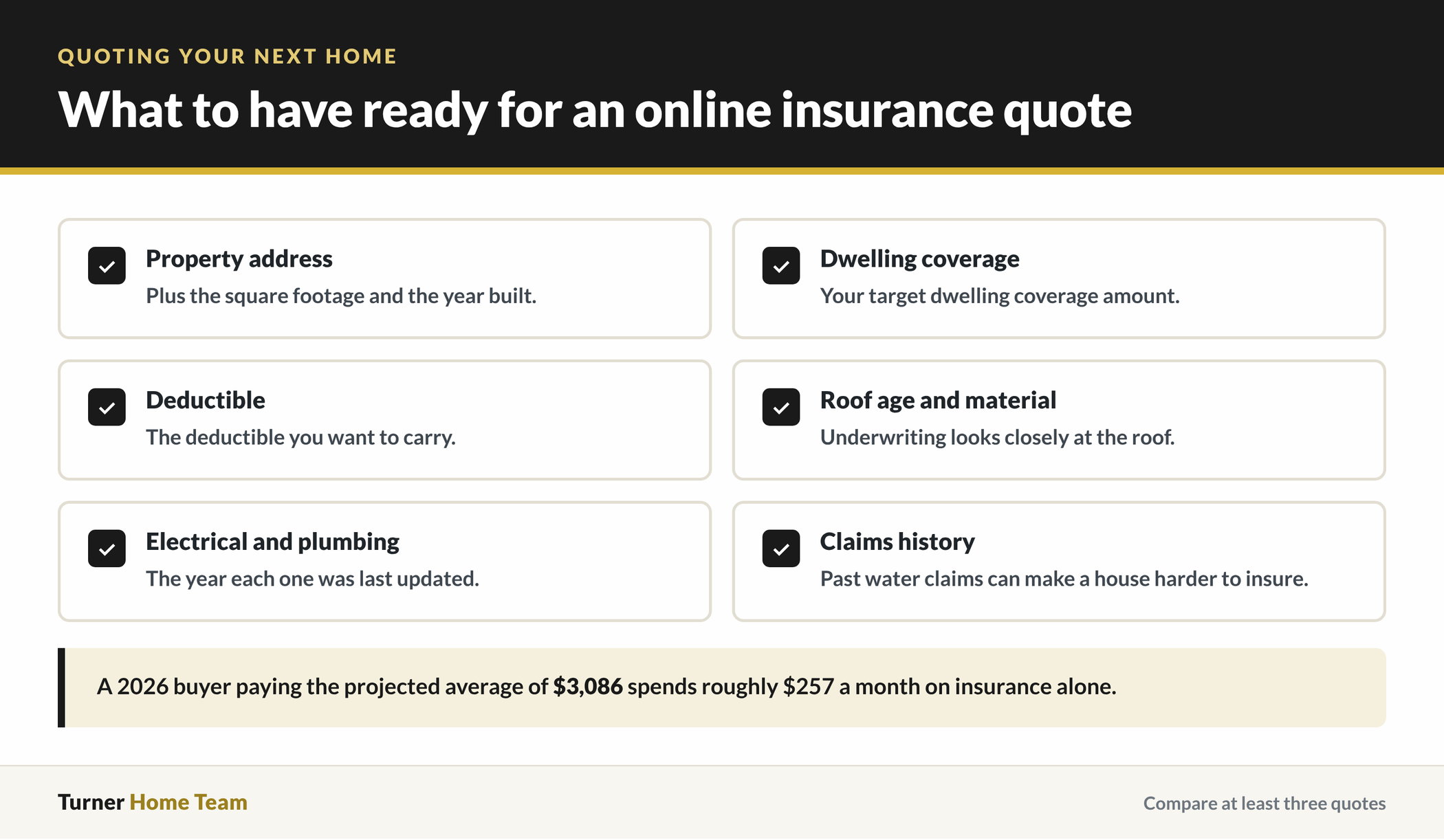
Have these ready before you start: the address, your target dwelling coverage amount, the deductible you want, the roof’s age and material, and the year the electrical and plumbing were last updated. Guesses produce a quote that won’t survive underwriting.
In harder markets, an independent agent is worth the extra day. They submit to several insurers at once and know which carriers are writing new business in your zip code. Where availability has tightened, that local knowledge beats any instant form.
Quote your new home before you commit to a purchase price, not after your offer is accepted. A buyer in 2026 paying the projected average premium of $3,086 spends roughly $257 a month on homeowners insurance alone, before principal, interest, or taxes. I’ve watched that line item change which house someone could actually afford. Compare at least three quotes at identical coverage limits and deductibles, or you’re comparing nothing. That goes double for sellers in North Carolina, who should line up insurance costs and coverage options before they settle on their next home.
Keep an eye on your inbox, too. Carriers send binders, declarations pages, and payment confirmations by email, and your lender needs those documents to fund.
Frequently Asked Questions
What Happens to My Homeowners Insurance After the House Is Sold?
Your policy doesn’t follow the house to the new owner. After the deed records, contact your carrier, request cancellation effective the closing date, and ask for a refund of any premium you paid past that date. If your premium was escrowed, the leftover escrow balance comes back separately from the insurer’s refund, so watch for both.
Does the Buyer’s Policy Cover Anything Before Closing?
No. Their coverage binds at their closing and protects their ownership interest from then on. Damage that happens while you still hold title falls under your homeowners insurance, which is why keeping yours active through the recording of the deed matters so much.
Carrying a house you’ve already moved out of? Maybe your closing keeps sliding and the vacancy clock is ticking. Either way, run the numbers before another month of premiums goes out the door. We’re happy to talk it through, whether you end up selling to us or listing with an agent down the street. No pressure, no obligation, just a straight answer about your options.
Ask Turner Home Team About Your House
If the vacancy clock is running on your policy, you can contact Turner Home Team for a straight answer about where you stand. You can also fill out the form below. There’s no obligation either way.