


A buyer once asked me to keep everything on hold for sixty days while his lender decided whether his bonus income counted. Sixty days. The seller had already moved three states away for a job, and she was covering two housing payments while a loan officer made up his mind. Contingencies carry that quiet cost. It’s a big reason selling with no contingencies has become a real option worth understanding, not a rare oddity saved for hot markets.
What Does Selling a House with No Contingencies Mean?
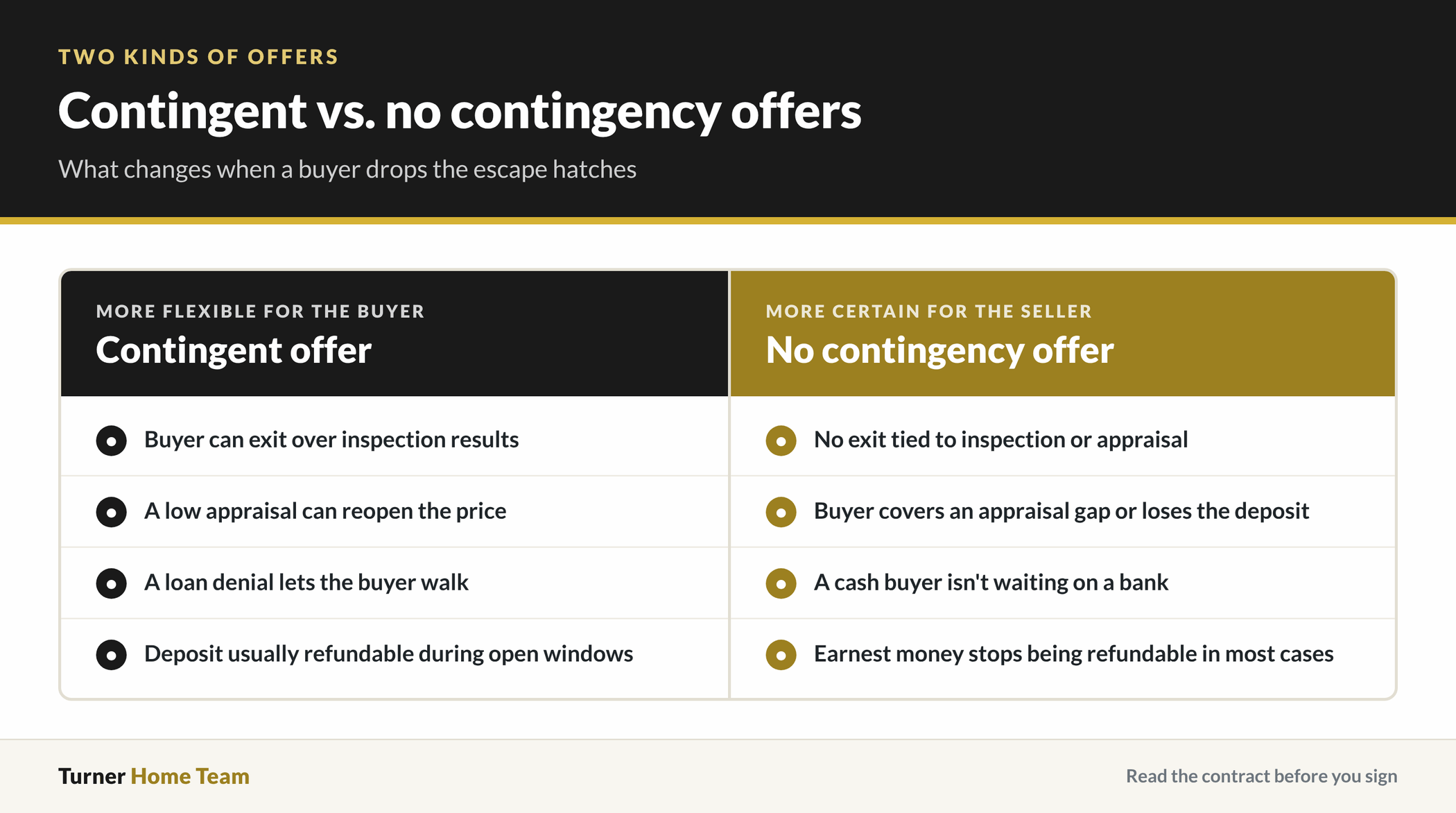
That cost shows up as time, not just money. A sale with no contingencies means the purchase agreement has no escape hatches tied to inspection results, a property appraisal, a buyer’s mortgage loan approval, or the sale of the buyer’s current house.
Contingencies are conditions written into a contract that let one party exit without penalty if something specific doesn’t happen. Take them out and the contract is binding in the plain sense of the word: perform or face consequences.
Most sellers hear the phrase and picture a cash buyer waving a check. That’s one version. Financed buyers sometimes waive protections too, which is a different animal entirely, and that distinction matters more than almost anything else here.
Three siblings in Rocky Mount called me early last year about their mother’s house. A contractor had priced a kitchen remodel at more than the kitchen would ever add back in value, and the youngest brother had already paid for half the cabinets sitting in the garage. They sold with none attached and skipped the project. Of the three, that one still strikes me as the smartest move.
The earnest money deposit anchors all of it. Once a buyer gives up their contingencies, that deposit stops being refundable in most situations, so it works as real collateral and not a polite gesture. A seller who accepts an offer with no contingencies trades flexibility for certainty, and the deposit is what makes that trade enforceable.
What Contingencies Do Buyers Usually Waive in a Home Sale?
A seller I worked with had a buyer who needed a home inspection, an appraisal, a lender’s underwriting sign-off, and the sale of a condo two states away. That’s four separate chances for it to fall apart. The replacement offer carried none of them and closed in under three weeks.
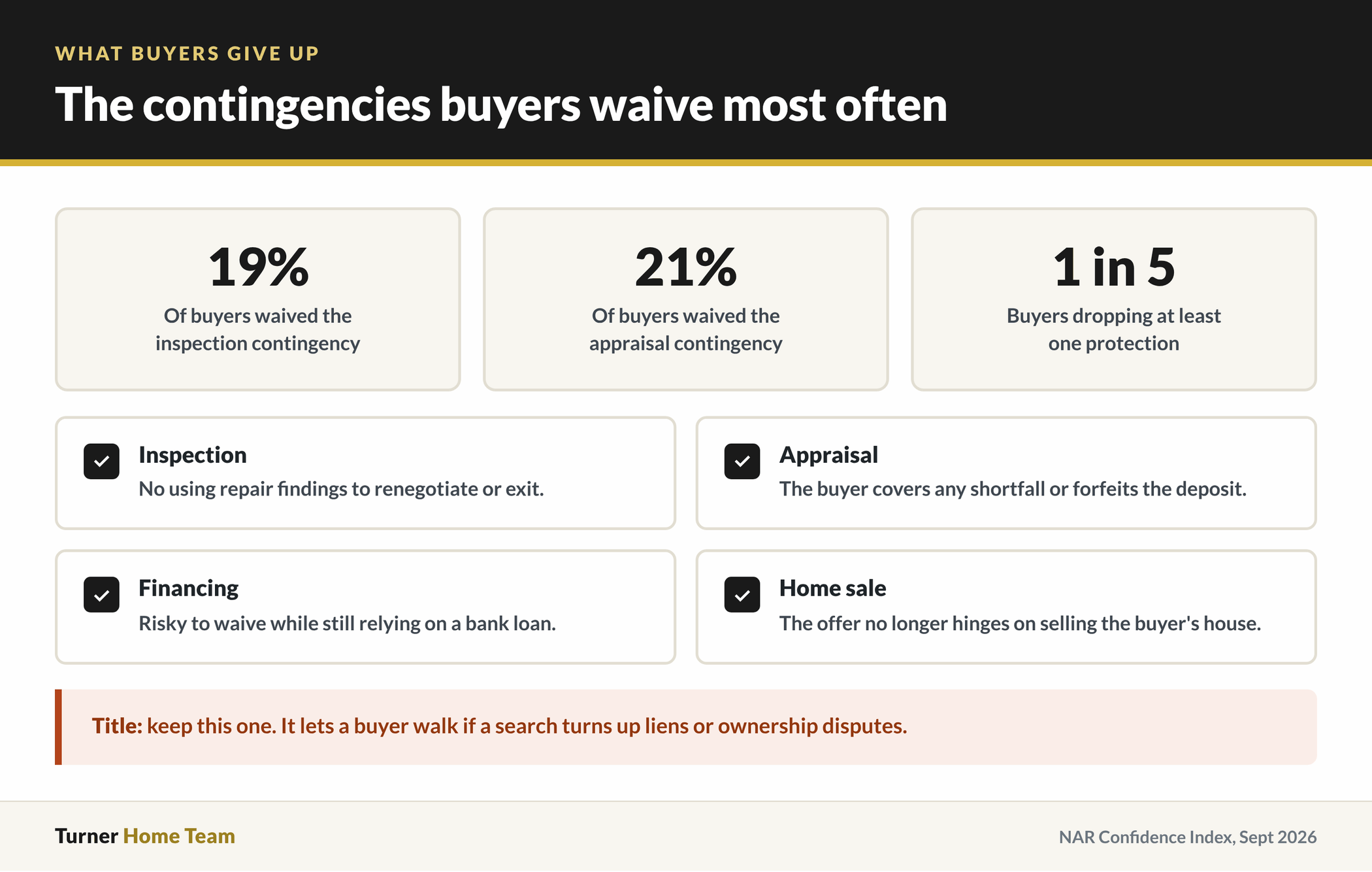
Inspection waivers usually come up first. The buyer agrees not to use repair findings as grounds to renegotiate or walk away.
Appraisal waivers follow close behind. If the property appraisal lands under the contract price, a buyer with no appraisal contingency covers the shortfall out of pocket or forfeits their deposit.
I’d watch financing contingencies hardest. That clause protects a buyer whose loan falls apart during underwriting, and waiving it while still leaning on a bank is a gamble homebuyers lose often.
Then there’s the home-sale contingency, where the buyer’s offer hinges on unloading their own property first.
Title contingencies are their own category. A title contingency lets a buyer walk if a search turns up liens or ownership disputes, and I’d argue against pushing any buyer to waive that one. Nobody wants a closing attorney finding an old judgment after the deed has already transferred.
You can measure how often buyers waive. NAR’s September 2026 Confidence Index found that 19% of buyers waived the inspection contingency and 21% waived the appraisal contingency. Roughly one in five buyers is already dropping at least one protection, and a true offer with no contingencies drops every one of them at once.
Why Would a Seller Accept an Offer with No Contingencies?
Your instinct may say the highest number on the page wins. I’ve watched sellers learn otherwise. The top offer comes with a financing clause, a two-week inspection period, and a buyer whose rate lock expires before closing. Meanwhile, the second-highest offer with no contingencies ends up worth more in dollars actually received.
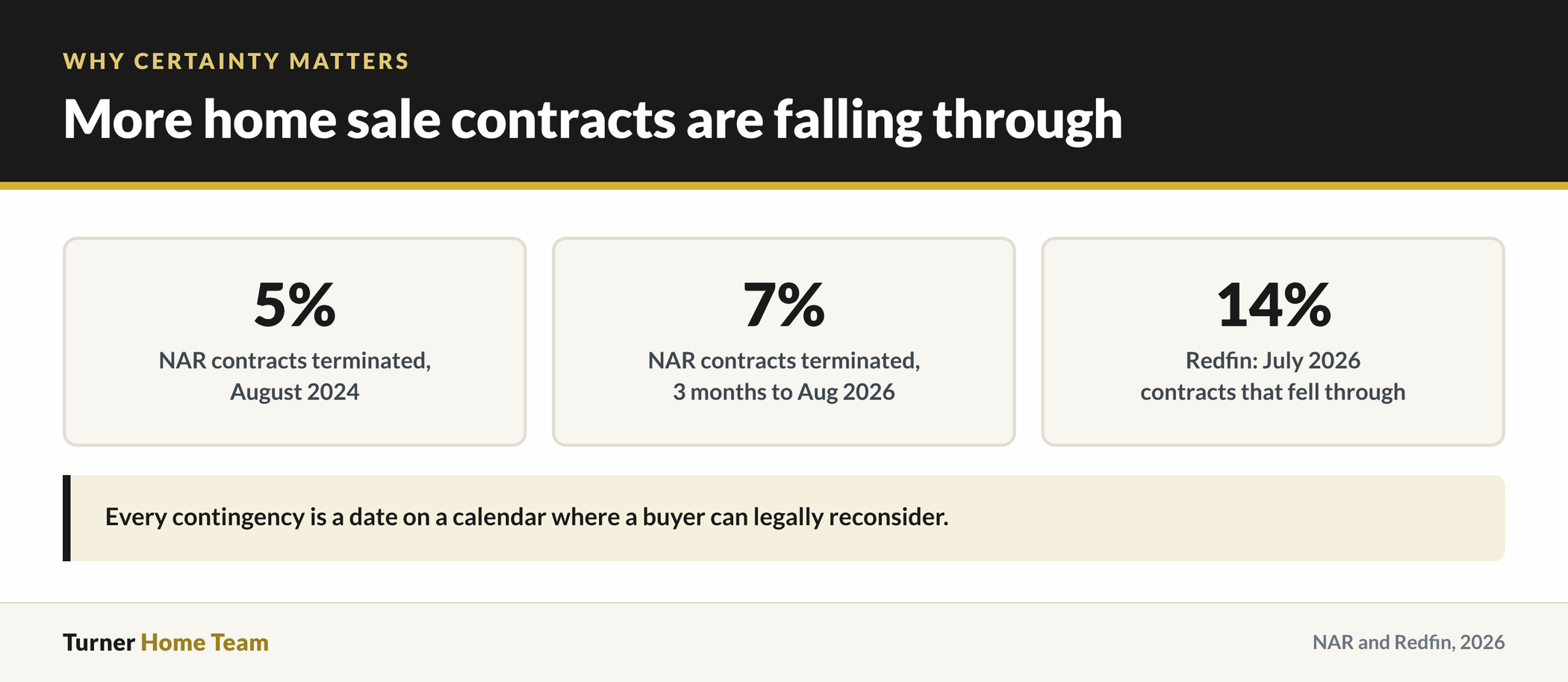
Every contingency is a date on a calendar where a buyer can legally reconsider.
Plenty of them fall apart. NAR’s data showed 7% of contracts were terminated in the three months ending August 2026, up from 5% in August 2024. Redfin tracks listings instead of surveying agents, and it found a higher share: 14% of agreements that went under contract in July 2026 fell through, the most in nearly three years. Slice the numbers any way you like and they point the same direction.
A collapse means relisting, re-staging, another round of showings, and a listing history that shows your property came back to market.
Sellers facing a job transfer, a divorce settlement, an inherited property, or a mortgage they can’t carry anymore usually value the closing date over the last few thousand dollars of price. That isn’t desperation. It’s arithmetic about carrying costs, repairs they won’t be making, and concessions they’d otherwise give up during an inspection period.
Direct buyers write offers this way on purpose. Turner Home Team buys with cash and writes contracts with no contingencies because they don’t need a bank’s permission, and that takes the uncertainty off the seller’s side of the table.
Are No Contingency Sales Common in Today’s Housing Market?
For years I told sellers that offers with no contingencies only turned up in frantic seller’s markets. I was wrong. They turn up whenever a buyer has cash and a motive, whichever way the market leans.
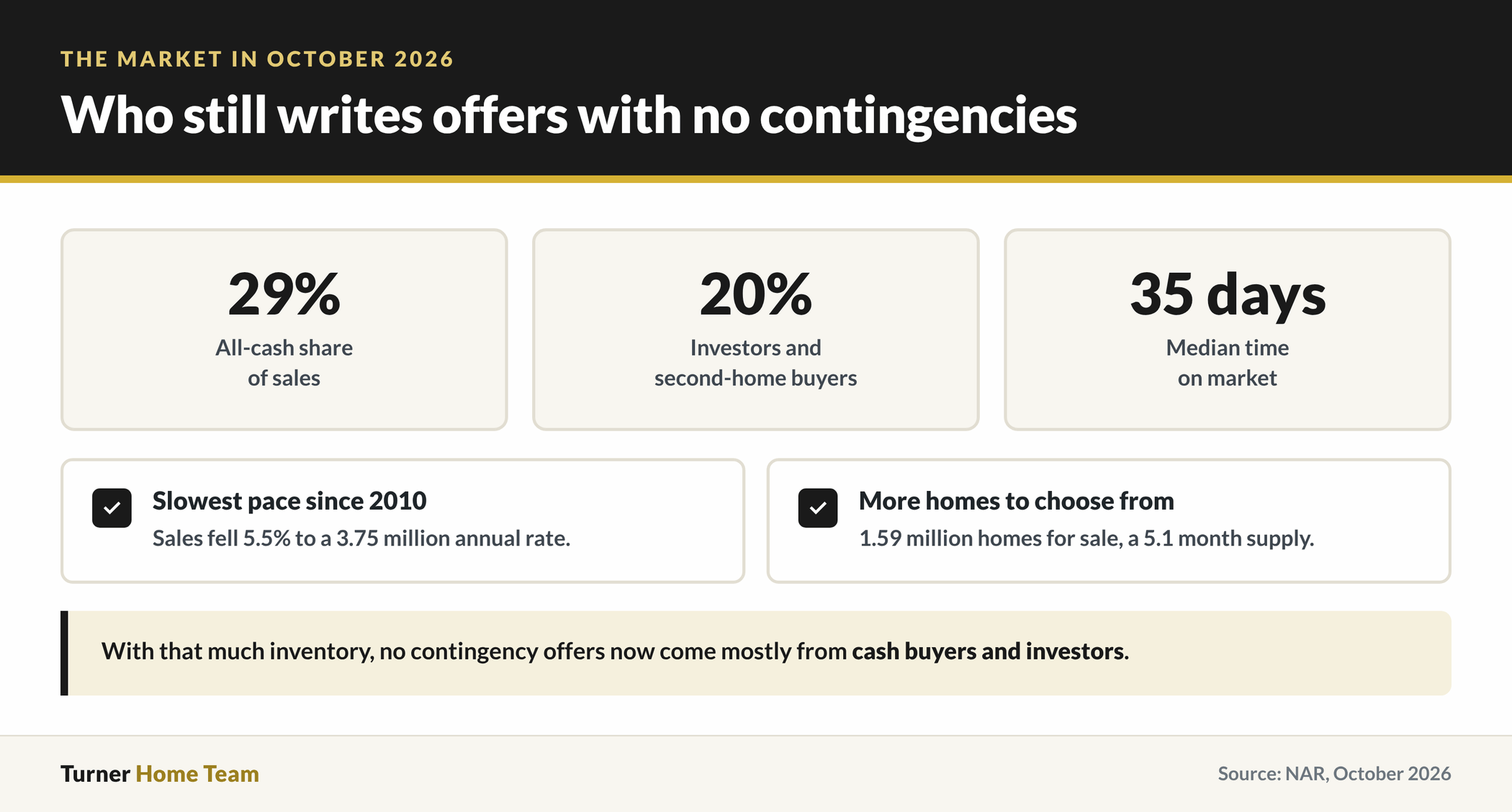
Existing-home sales fell 5.5% in October 2026 to an annual rate of 3.75 million, the slowest pace NAR has recorded since August 2010. Median time on market hit 35 days that month, up from 33 in September and 34 a year earlier. The full NAR release on existing-home sales has the rest.
Cash is holding its ground. All-cash transactions made up 29% of sales in October 2026, up from 27% in September. Anyone paying cash is best placed to write an offer with no contingencies, and nearly three in ten sales now come from that group.
Investors and second-home buyers made up 20% of October 2026 sales, up from 16% a year ago.
This is where the market shift changes things for you. With 1.59 million homes for sale and a 5.1-month supply in October 2026, traditional buyers have room to negotiate and little reason to waive anything. Retail homebuyers fighting over scarce listings waive contingencies; retail homebuyers with 1.59 million options don’t.
So the offers with no contingencies landing in your inbox now come almost entirely from investors and people paying cash. A family who fell in love with your kitchen isn’t usually the one writing them.
Is Selling Without Contingencies Risky for Homeowners?
Pick the wrong offer with no contingencies and you can lose six weeks and your closing date, thinking the whole time you were protected.
A financed buyer who waives the financing contingency can still watch their loan die in underwriting. All they’ve given up is their right to a refund. If the lender says no, you keep the earnest money and start over, which is cold comfort once you’ve signed a lease somewhere else.
Loan denials aren’t rare. Roughly 13% of mortgage applications to buy a home that reached a decision in 2025 were denied, based on HMDA analysis of federal lending data. Ask for proof of funds, like a bank statement or a letter from the institution holding the money, dated within the last thirty days.
Price is the second risk. Buyers who skip contingencies price in the unknowns they’re taking on, so expect a number below full retail. Weigh that discount against what you’d spend getting the property ready, how long you’d wait, and your monthly carrying costs. Plenty of sellers measure it against a list price they made up. The fair yardstick is what a listed sale would really net after commissions, repairs, concessions, and three more mortgage payments.
You still have to disclose known material defects, and the rules vary by state. Your state’s real estate commission can tell you what your disclosure form requires.
How Do No Contingency Offers Affect the Closing Timeline?
A widowed homeowner in New Bern had to close before her new assisted living unit got handed to someone else.
Contingency periods are the slow part of almost every transaction, since each stage waits its turn behind the one before it. Inspection windows run a week or two. Appraisals get ordered, scheduled, completed, and reviewed. Strip those out and you’re left with title work and the deed.
NAR reported that contracts typically closed in 30 days in its September 2026 survey, unchanged from a month and a year earlier. Sales with no contingencies routinely close faster, because title search and clearing is usually the only step left.
The conventional path runs late a lot. Sixteen percent of contracts had delayed settlements over the past three months in NAR’s September 2026 reporting, up from 14 percent in August. NAR’s chief economist pinned part of that on buyers whose rate locks ran out before closing, leaving them with higher payments. Inman’s coverage of the September report has the detail.
An unreleased HELOC, a probate gap, an old mechanic’s lien: none of those clear faster just because the contract has no contingencies. ordering the title search the day you sign is the single best thing you can do for your closing date.
Would a faster close really help you, or would it set off a scramble to find your next place? Answer that before you chase speed.
What Should You Ask Before Removing Contingencies From a Contract?
Taking a contingency out after a contract is signed usually requires a written amendment that both parties execute. A phone call or a handshake won’t cut it. Verbal agreements about contract terms are hard to enforce, and the paperwork protects you as much as the buyer.
Start with the money. Who’s paying for this, where are the funds sitting right now, and can I see documentation today?
Then the deposit. How much earnest money is going up, who holds it, and when does it get released to me? A deposit that’s a rounding error hands the buyer a cheap exit even with no contingencies in the contract. Real security is a substantial deposit held by a neutral escrow agent or title company.
Next, ask what the agreement still contains once the contingencies come out. Depending on your state, some contracts keep a title review clause, a walkthrough right, or an attorney review period. Know what’s still live.
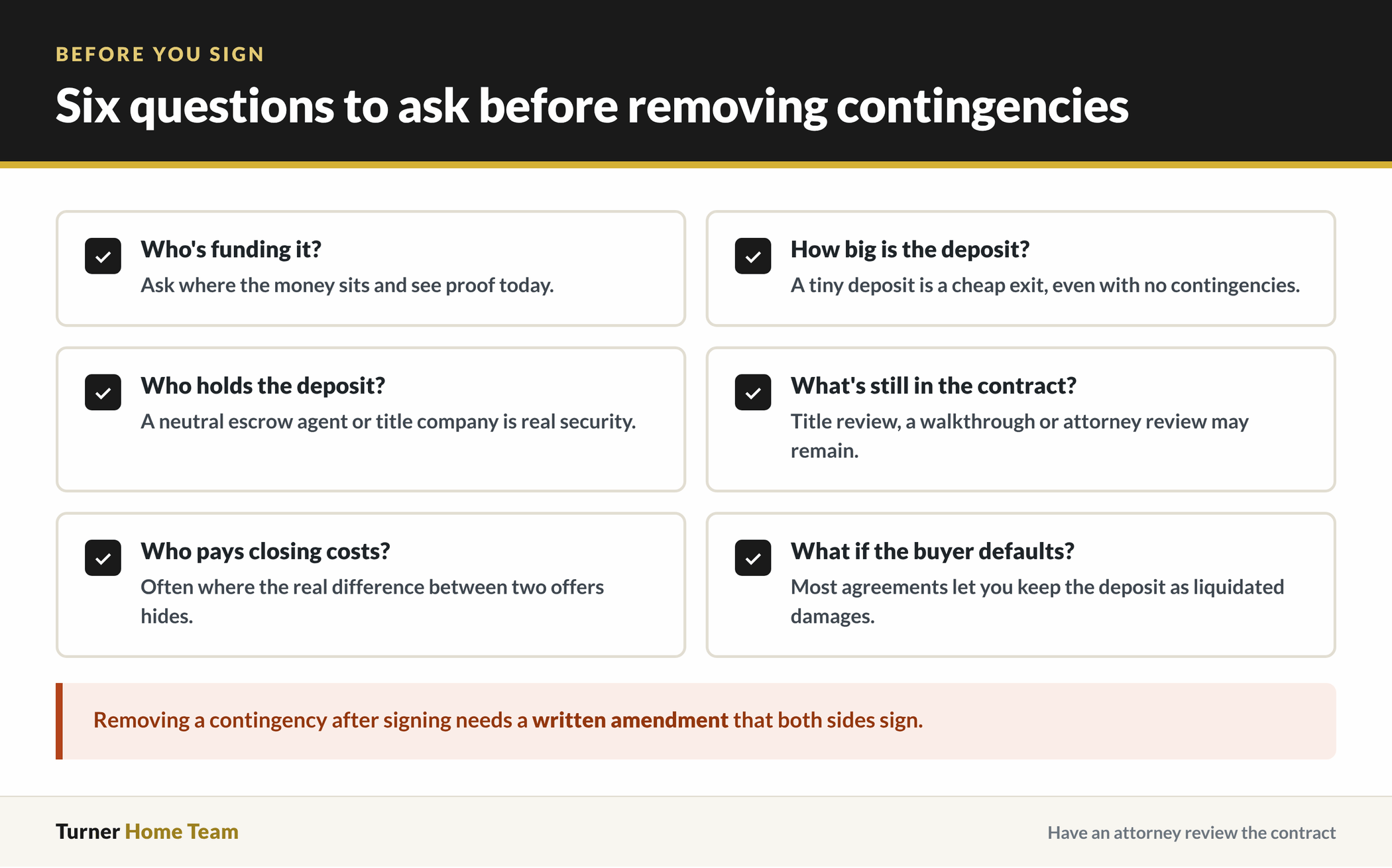
Who’s paying closing costs? In an offer with no contingencies, this is often where the real net difference between two offers hides. A slightly lower price with the buyer covering title and transfer fees can beat a higher price where you’re absorbing everything.
And if the buyer defaults anyway? Most agreements let the seller retain the deposit as liquidated damages, though the details depend on your state’s contract law and what the form says.
Have an attorney or a trusted agent read the agreement before you sign. Buyers who work with sellers every day, including teams like Turner Home Team, will tell you to get your own set of eyes on the contract. Anyone who discourages that is the wrong buyer.
How Do You Decide If a No Contingency Offer Is Right for You?
The national median existing-home price was $416,700 in October 2026. With numbers that size, choosing between two offers can swing tens of thousands of dollars, so it deserves a worksheet over a gut feeling.
Build the comparison on net proceeds and calendar days, not headline price. On the listed side, subtract agent commissions, pre-listing repairs, inspection-driven concessions, and your monthly carrying cost times the weeks you’ll wait. On the other side sits a firm number and a firm date.
Some situations tilt the math toward an offer with no contingencies even when the gross price is lower. Think of a tenant who won’t cooperate with showings, a house full of a parent’s belongings, a work transfer with a start date, or a sibling who wants out of a shared inheritance.
In Fayetteville, a woman reached out while settling her father’s estate and finishing a divorce at the same time. His workshop was still full of welding equipment nobody in the family wanted. She told me she’d rather lose a little on price than spend another Saturday sorting through it. We bought it with no contingencies and closed on the date her attorney needed for the property settlement.
If you need to sell your house in North Carolina, weighing a guaranteed closing date against a possibly higher offer can show you which option fits your timeline and your finances better.
Which matters more to you, the highest possible price or the certainty of a specific date?
Frequently Asked Questions
Can a Seller Back Out of a Sale with No Contingencies?
It’s much harder than most sellers hope. Once you’ve signed, you’re bound to perform, and a buyer can potentially sue for specific performance to force the transfer. A few contracts include seller termination rights and some states carve out narrow exceptions, so talk to a real estate attorney in your state before you assume there’s an exit.
Does Selling with No Contingencies Mean I Can’t Disclose Problems?
Not at all. Your disclosure obligations stand however the contract is written, and hiding a known material defect can expose you to liability long after closing. Tell the buyer about the foundation crack and the roof leak; a buyer writing an offer with no contingencies is usually pricing for condition anyway.
Will I Get Less Money Selling with No Contingencies?
Often, yes, on the gross price. The buyer is taking on repair risk, valuation risk, and schedule risk, and that shows up in the number. Before you decide the gap is as wide as it looks, compare it with what you’d actually net after commissions, repairs, concessions, and months of payments.
Is Earnest Money Always Non-refundable in These Deals?
The buyer’s deposit is generally at risk once the protections are gone, but the exact terms live in your contract. Some agreements still allow a refund if the seller can’t deliver clear title or fails to perform. Read the default and remedies language closely, and have someone qualified confirm what it means where you live.
Sitting on a house and wondering whether an offer with no contingencies fits your situation? I’m happy to walk through the numbers with you, including the ones that argue against selling to someone like me. Reach out to Turner Home Team whenever you’re ready to sell your house in Raleigh and other cities in North Carolina. No pressure, no obligation, and no hard feelings if listing turns out to be the better call.
Get a Straight Answer on Your Offer
Curious how an offer with no contingencies stacks up against listing? You can contact Turner Home Team, and we can go over the numbers with you. The form below works too.