
A seller in Jacksonville called me last spring, sure she owed the IRS a third of her sale price. She’d bought the house in 1994 and raised two kids there. A neighbor had told her the tax would eat her retirement, and she nearly turned down a good offer over it.
She owed nothing. Not one dollar of capital gains tax.
I hear some version of her story from sellers every few weeks, which is why I wrote this. The rules around a home sale take some sorting out, though they’re nowhere near the monster people picture. Let’s figure out which ones apply to you.
What Is North Carolina Capital Gains Tax on a Home Sale?
Most homeowners who sell their primary residence in North Carolina never pay a penny of capital gains tax. The panic around the subject still pushes people into bad decisions.
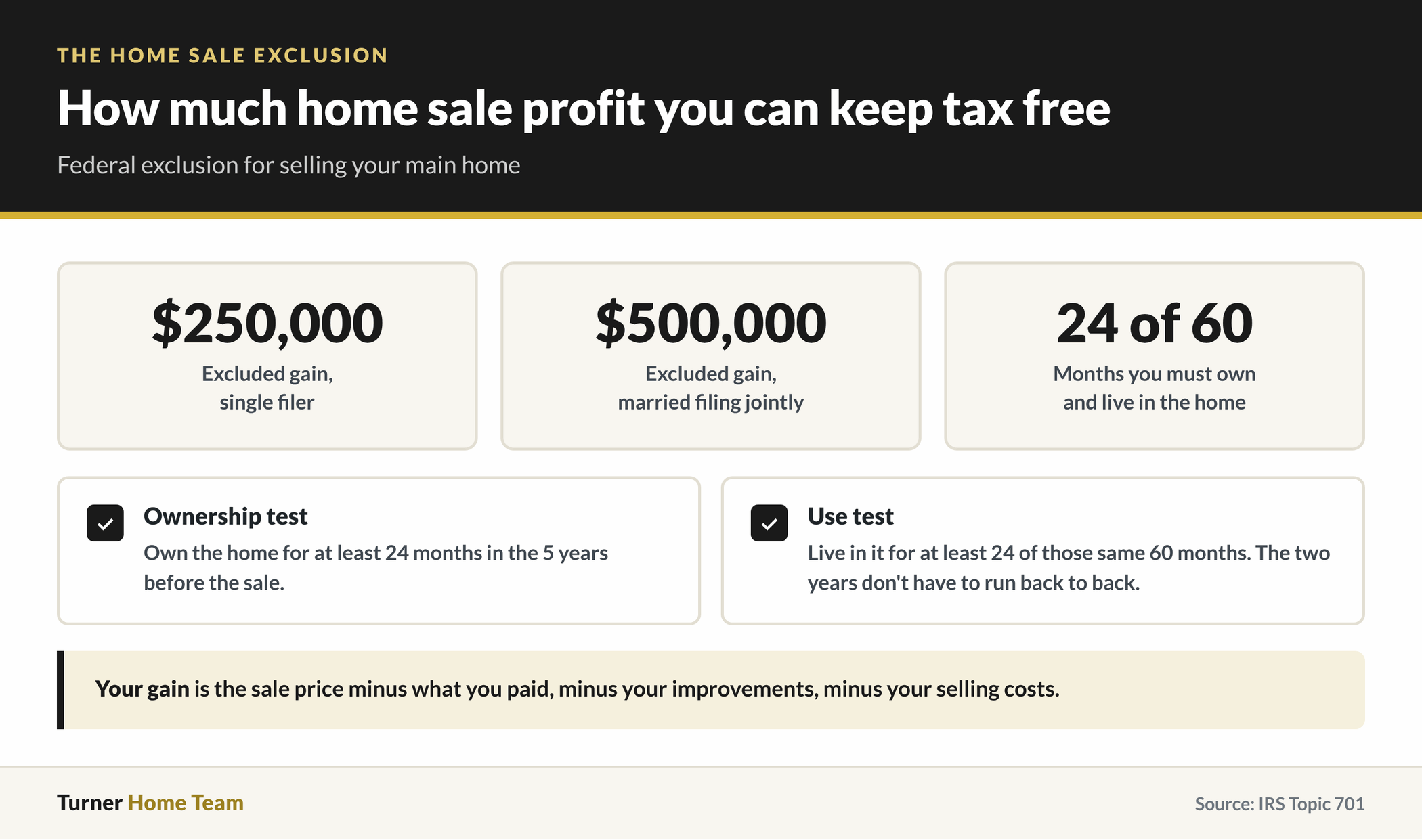
A capital gain is just profit. Start with what the buyer pays you. Subtract what you originally paid, the improvements you’ve made over the years, and your selling costs, and whatever’s left is your gain. The IRS looks at that number, not your sale price or your equity.
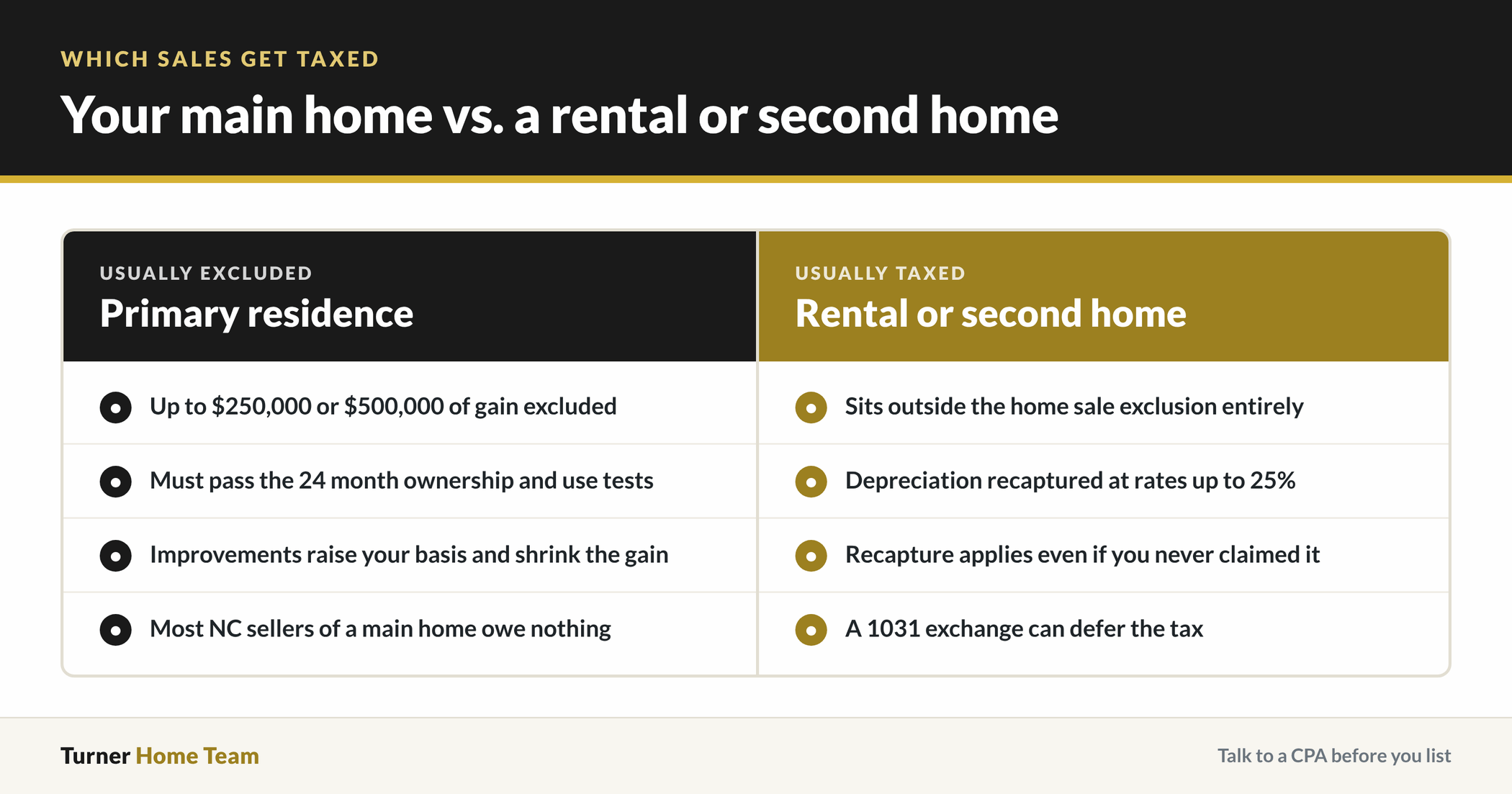
The exclusion is where it gets good. Sell your main home at a profit and you may be able to exclude up to $250,000 of that gain from your income. On a joint return with your spouse, the limit is $500,000, according to the IRS at Topic 701. A married couple in North Carolina with half a million in profit can walk away clean.
So how do you qualify? Owning the home for at least 24 months out of the five years before the sale meets the ownership test. Living in it for at least 24 of those same 60 months meets the use test, and the two years don’t have to run back to back.
A couple of years ago I bought a brick ranch in Kernersville from two adult children. Their mother had just moved into assisted living, and they were certain a tax bill was coming for her. She’d lived there since the Carter administration. Her gain looked large on paper, yet it sat well under the single-filer exclusion. Her late husband’s workbench was still bolted to the garage wall.
Gains above the exclusion do get taxed, at the federal and the state level. That’s the part worth planning for before you sell.
Does North Carolina Have Its Own Capital Gains Tax Rate?
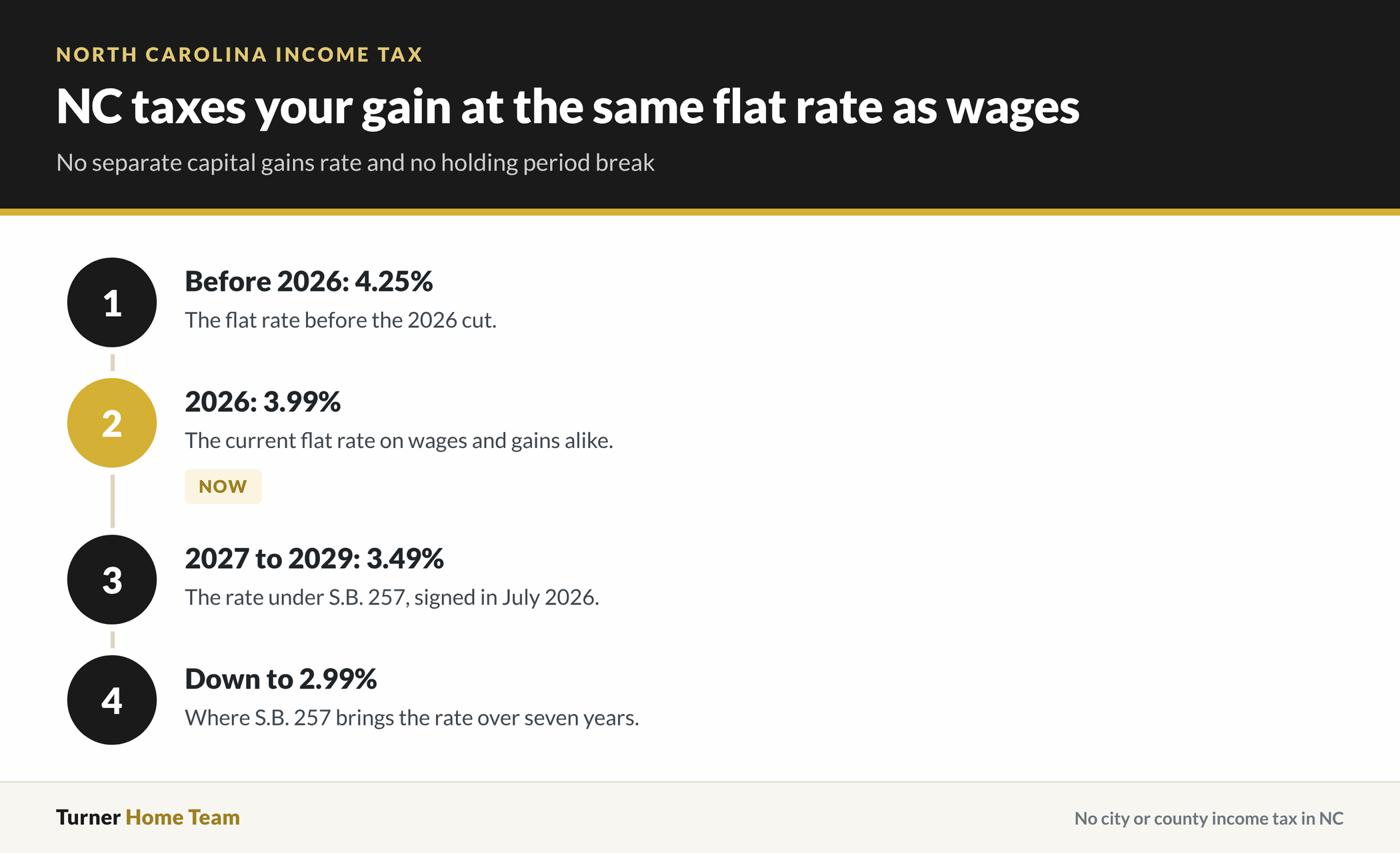
North Carolina doesn’t give long-term gains any break over short-term ones. The state treats both exactly like wages.
You feel that most when you compare states. Gains flow into North Carolina taxable income at the same flat rate, with no capital gain deduction, no holding-period break, and no separate schedule. A gain you held for eleven months hits your D-400 the same way as one you held for thirty years.
That flat rate keeps falling. For 2026, the individual income tax rate fell from 4.25% to 3.99%, verified against NCDOR rate pages per this CPA breakdown. Then in July 2026, Governor Josh Stein signed S.B. 257. It brings the rate down to 2.99% over seven years, with 3.49% applying for tax years 2027 through 2029.
A North Carolina seller with taxable gain left after the federal exclusion pays state tax on that remainder. Counties don’t pile on, either. You won’t find a city or county income tax anywhere in the state.
Would waiting a year to sell shrink your state bill? Not on its own. The scheduled rate cut might save you a little, but a year of carrying costs usually swamps a quarter-point of tax savings. Insurance, heat, and upkeep keep running while you wait. I’ve watched sellers hold a vacant house through a whole winter chasing a tax edge that never covered the insurance and the heat.
Your exact North Carolina tax figure on those gains depends on your federal adjusted gross income, since the state return follows the federal one. Get the federal math right first.
How Much Is Federal Capital Gains Tax on Real Estate in North Carolina?
Zero percent. It’s a real federal rate, and plenty of North Carolina sellers land on it.
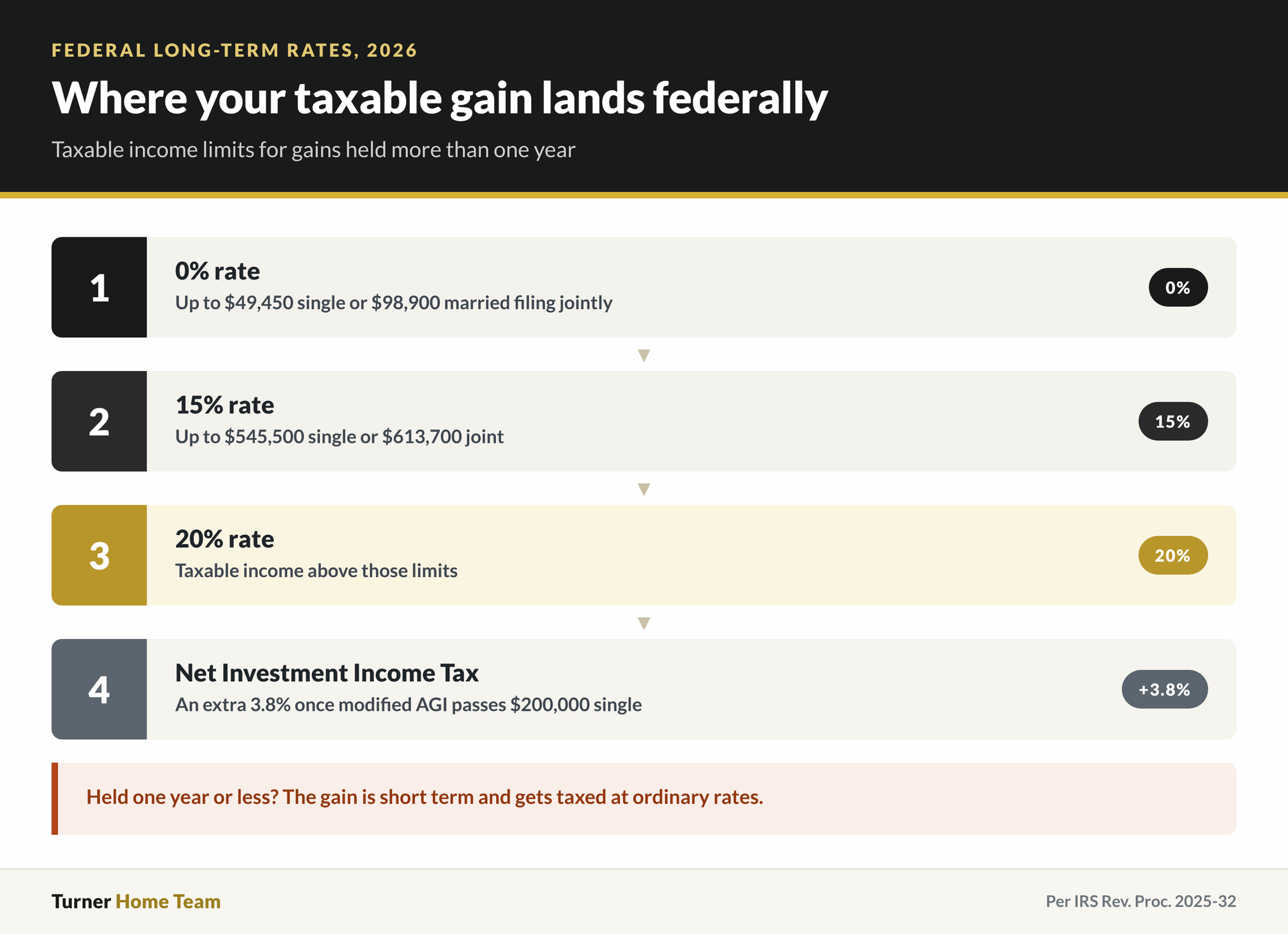
For tax year 2026, the long-term capital gains rate is 0 percent up to $49,450 of taxable income for single filers and $98,900 for married couples filing jointly. It’s 15 percent above that, up to $545,500 single or $613,700 joint, then 20 percent, per this summary of IRS Revenue Procedure 2025-32. I’ve seen retirees on modest income pay nothing federally, even on gain beyond the exclusion.
Higher earners hit one more wrinkle. An extra 3.8% Net Investment Income Tax applies to investment income, capital gains included, once modified AGI passes $200,000 single or the married filing jointly threshold.
Your holding period sets your federal rate. You have to hold an asset more than one year to get the preferential rates, so selling on the exact one-year anniversary still produces a short-term gain taxed at ordinary rates. Flippers learn this the hard way.
Now put a North Carolina price tag on it. Statewide, homes sold for a median price of $368,456 in October 2026, down 1.1% from a year earlier, according to Redfin’s market data. If you bought at that level and sell at that level, there’s no gain to tax and the math stays simple. The people facing a real tax question usually bought in Durham or Wilmington twenty years ago, or own something beyond a primary residence.
What Happens to Capital Gains Tax on Rental and Coastal Property Sales?
A landlord I worked with near Southport had rented his three-bedroom to travel nurses for eleven years. He figured the home sale exclusion covered him because he’d lived there once, way back at the start.
It didn’t. Rental property and second homes sit outside the exclusion entirely, and they’re where most North Carolina capital gains bills come from.
Depreciation is the part that stings. Every year you rent a property, you deduct depreciation against your rental income, and the IRS recaptures that deduction when you sell. Recapture gets taxed at ordinary rates up to 25 percent, separate from your long-term gain. Even if you never claimed depreciation, the IRS figures recapture as though you did.
Beach sellers run into a version of this too. Coastal North Carolina markets draw a mix of full-time residents, vacation buyers, and active-adult retirees. A cottage on Emerald Isle you rent out six weekends a summer may count as investment property.
Kept track of your improvements? Every new roof, every HVAC replacement, and every addition raises your cost basis and shrinks the gain. Receipts from 2009 are worth real money at closing, and the sellers who kept a folder in the kitchen drawer pay less of it than the ones who didn’t.
Investors selling rentals have a tool homeowners don’t: the 1031 exchange, which defers the tax when proceeds roll into another investment property. The deadlines are strict, and a qualified intermediary has to hold the money. Have your CPA map it out before you list, not after.
Does Timing Your Home Sale Change Your Capital Gains Tax Bill?
“If I close in January instead of December, does it help?”
It can. The gain lands in whatever tax year your closing falls in, so a December 28 closing and a January 4 closing land on completely different returns. If your income will drop next year, pushing the closing moves the gain into a cheaper bracket.
The two-year rule is a bigger timing lever. A seller eleven months into living in a home can wait out the calendar and turn a fully taxable gain into an excluded one. Nothing else in tax planning pays that well for sitting still.
Market timing works the other way. I’d rather see you take a strong offer than hold out for a better season. In Wake County, homes sold after about 50 days on the market in October 2026, compared to 46 days a year earlier, per Redfin’s county report. Those extra days are carrying costs, and they come out of the same pocket the tax does.
Divorce and death scramble the timing math. I’ve seen grieving spouses lose track of the clock while they just try to get through the paperwork. A surviving spouse may take the higher exclusion by selling within two years of the spouse’s death and not remarrying before the sale. Neither spouse can have claimed the exclusion on another home sold less than two years earlier, per IRS Publication 523. Missing that window by a month can cost a widow real money in taxes.
Partial exclusions exist for job changes, health moves, and other unforeseen circumstances, so check before you write off the benefit. Sellers in North Carolina relocating for a Charlotte banking job often qualify for a prorated amount. Ask before you sell.
How Can You Reduce Capital Gains Tax When Selling a House in North Carolina?
Go dig through your bank statements and credit card history for every dollar you’ve put into this house. I mean it.
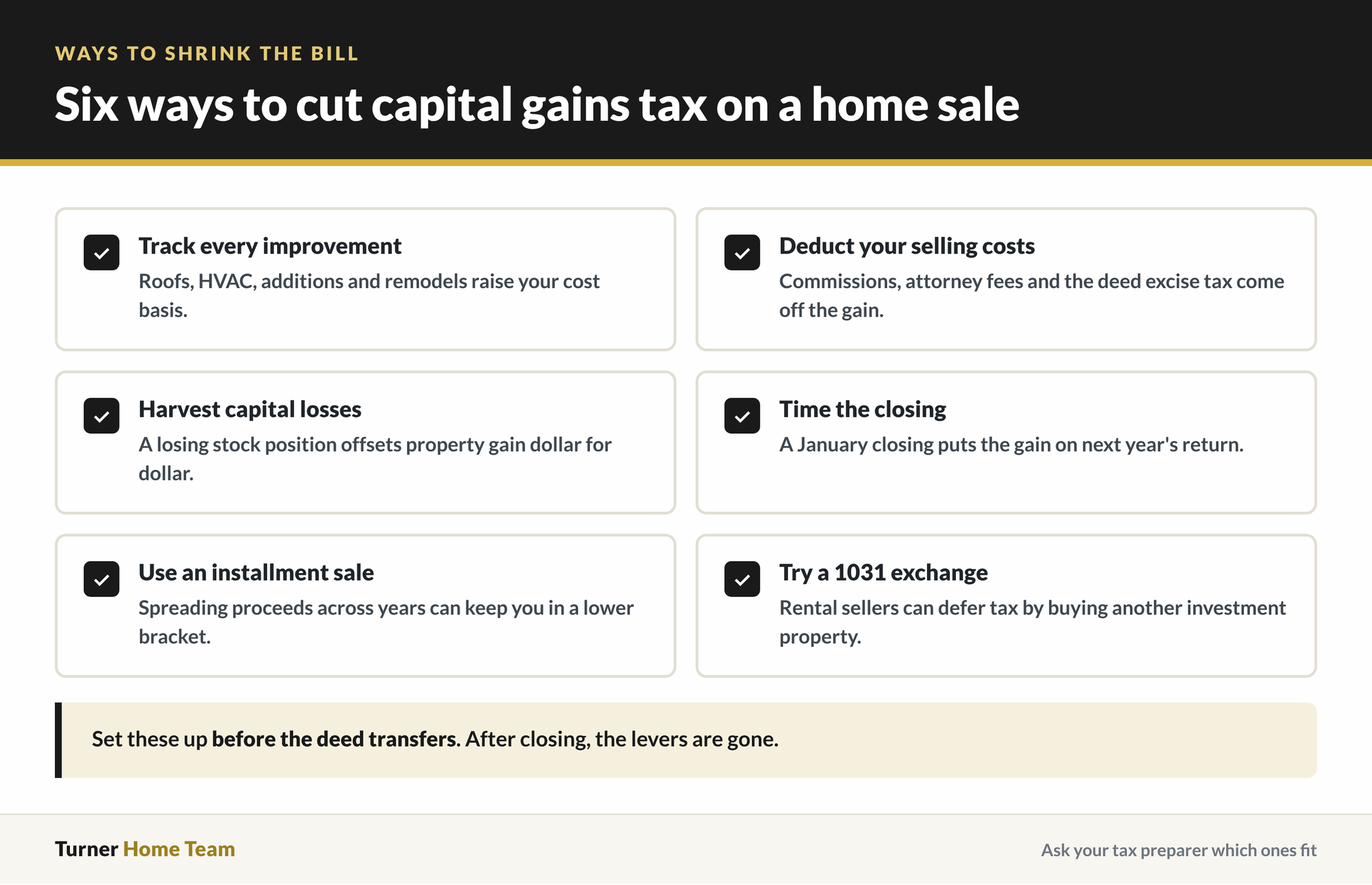
Basis is the most underused defense against capital gains tax, and you control it completely. Kitchen remodel, new septic, finished basement, deck, replacement windows: all of it raises what the IRS treats as your cost. Routine repairs don’t count, but a lot of what you’ve spent over the years probably does.
Selling costs come off the top too. Agent commissions, closing attorney fees, and the state’s deed excise tax all reduce your gain directly. To give you a sense of scale, that excise tax runs $6,000 on a $3 million sale.
Three more moves worth raising with your tax preparer:
Harvest capital losses in the same year you sell. A losing stock position offsets property gain dollar for dollar.
Move back in. Turning a rental back into your primary residence for two years restores part of the exclusion, though depreciation recapture still applies and the allocation rules get technical.
Set up an installment sale. Spreading the proceeds across years can keep you inside a lower bracket.
A couple in Kannapolis had been quietly paying two mortgages for almost a year when they reached out. They’d bought the new place on a Friday in the fall and never got the old one sold. The bonus room over the garage they’d been so proud of was full of unopened moving boxes. Their gain was modest; the bleeding wasn’t. Selling as-is stopped the second payment, and the capital gains tax question turned out to be the smallest problem on their list. If a house you’re carrying has become the expensive part of your month, Turner Home Team can tell you quickly what an as-is sale looks like.
Do You Need a Financial Advisor to Handle Capital Gains Tax Planning?
For years I told sellers to call a CPA only if their gain looked big. That was bad advice.
The sellers who get hurt rarely have the largest gains. They have a complication nobody flagged: an inherited house with a stepped-up basis they never figured, a rental converted from a primary residence, a divorce decree that split ownership oddly. Call before you sign anything. A one-hour visit with a North Carolina CPA costs a few hundred dollars and routinely saves several times that.
What should you bring? Your original closing statement, every improvement receipt you can find, and your last two years of returns. If the property was ever rented, bring the depreciation schedules too.
Real estate attorneys matter here as well, especially on inherited property. Heirs selling a family home in Greensboro or Hickory often get a basis reset to the date-of-death value, and that can erase the capital gains tax question completely. Nobody mentions it unless they ask.
The statewide median closed sale price sat at $357,999 across 89,040 closings tracked over the six months ending October 2026, per this North Carolina market report. At those price points, most primary-residence sellers here won’t owe capital gains tax at all. A quick professional check confirms it in one sitting instead of leaving you guessing for months.
Here’s a pattern I keep running into. Sellers wait until after closing to ask the tax question, and by then the levers are gone. Every strategy worth using (timing, basis records, an exchange) has to be in place before the deed transfers.
If your situation has moving parts and you want someone local who’s handled hundreds of these, the folks at Turner Home Team know which questions go to which professional.
Frequently Asked Questions
How Can I Avoid Paying Capital Gains Tax When I Sell My House?
Live in the house as your main home long enough to meet the ownership and use tests above, and the federal exclusion wipes out most or all of a typical seller’s gain. Beyond that, keep good records of every improvement so your basis is as high as it honestly can be. If the property is an investment and not your residence, a 1031 exchange defers the tax when you reinvest in another property.
How Do I Calculate Capital Gains on the Sale of a Property?
Start with your sale price and subtract your selling costs like commissions and attorney fees to get your net proceeds. From there, subtract your adjusted basis, which is your original purchase price plus every capital improvement you made over the years. What’s left is your gain. On a rental, you’ll also owe recapture on the depreciation you claimed.
Does North Carolina Tax the Sale of an Inherited House?
Inherited property usually comes with a basis adjusted to its fair market value on the date the previous owner died. Sell soon after and your gain is often small or nothing at all, so the capital gains tax may be minimal. Get a date-of-death valuation in writing early, since rebuilding it years later is hard and expensive.
If the tax question is what’s holding up your decision, we’re glad to talk it through with you. No pressure, no obligation, and no hard sell if selling isn’t the right move for you right now.
Talk Through Your Sale With Turner Home Team
Not sure how capital gains tax fits your plans? You can reach out to Turner Home Team and talk it over with no pressure. Or fill out the short form below, and we’ll get back to you.