
The house has been sitting since July. Showings dried up in September, and your broker stopped returning calls three weeks ago. Meanwhile the contract you signed still has four months left on it. So now you’re wondering if you’re stuck.
You’re probably not. A listing agreement in North Carolina is a contract between you and the brokerage firm, not a life sentence, and there are several legitimate ways out of one. Some cost you nothing. Others cost you something. Which one fits depends on what the paperwork says and how reasonable your broker decides to be.
Why Would You Want to Terminate a Listing Agreement?
Across North Carolina, the median time on market hit 71 days in October 2026, according to Realtor.com data tracked by the St. Louis Fed. Add a few weeks of price arguments and one failed inspection, and you’re half a year in with nothing to show for it.
A seller who gets no showing feedback, no email updates and no marketing plan beyond a yard sign has a legitimate grievance.
Life changes the math, too. A job transfer to Charlotte, a parent who needs care in Greensboro, a divorce filing or a mortgage that got heavier after a layoff can all do it. The property that made sense in spring doesn’t make sense in November.
Then there’s the marketing itself. Dim phone photos, no floor plan, no video and no sign of the property on any syndicated site. A broker who promised professional marketing and delivered a lockbox left a gap worth raising before you raise anything else.
Not long ago I worked with an heir down in Greenville who’d inherited her aunt’s brick ranch from two states away. She watched two separate listing agreements expire without a single written offer. By the second expiration, the only thing left in the garage was a rusted chest freezer nobody had opened since the funeral. She didn’t need a third broker. What she needed was the house sold.
Price fights end plenty of these relationships as well. Your broker wants a cut, and you think the number is already low. Neither of you is lying, though a listing agreement built on a price you resent won’t produce a sale either of you likes.
What Does North Carolina Law Say About Listing Agreement Cancellations?
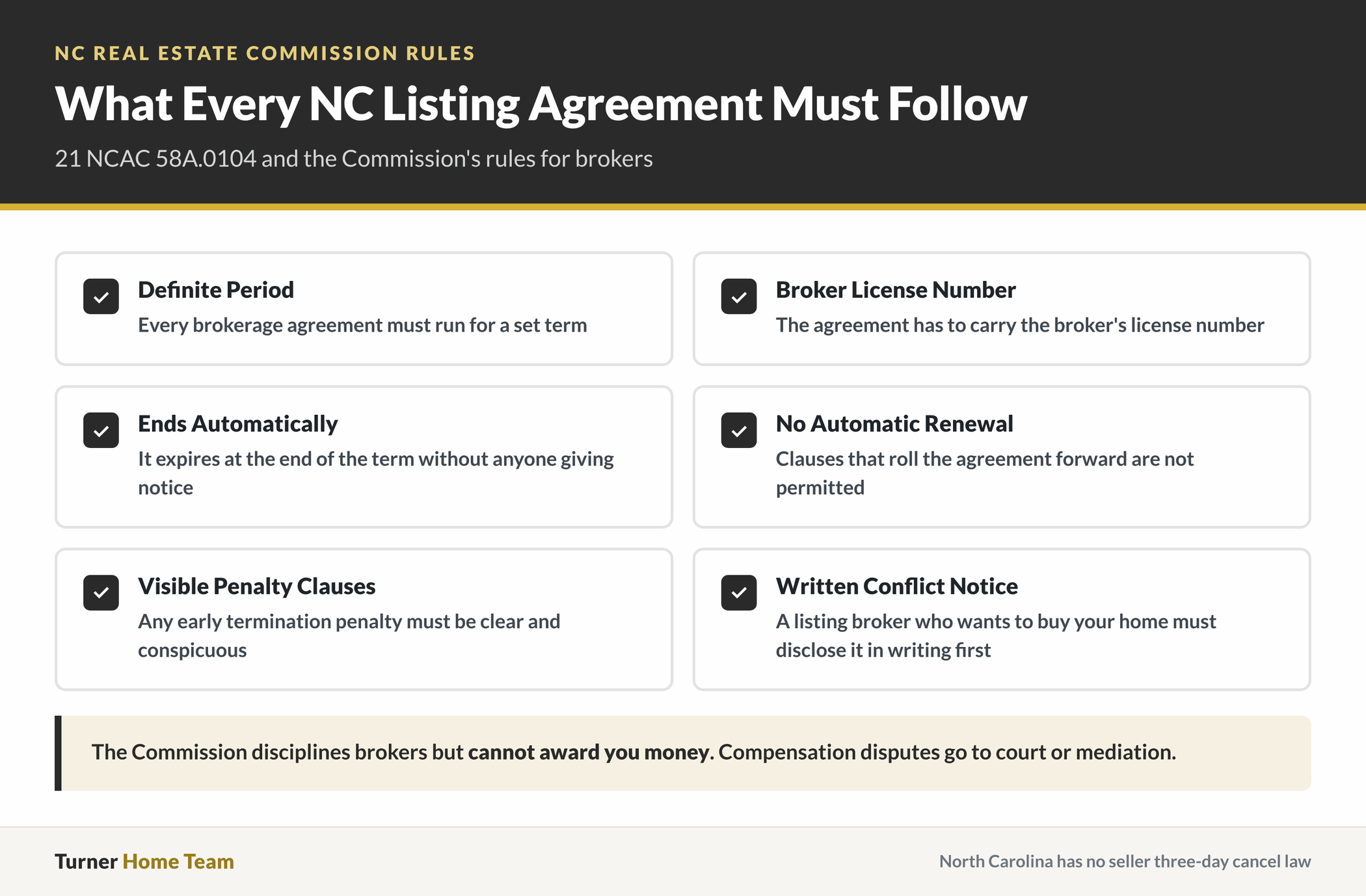
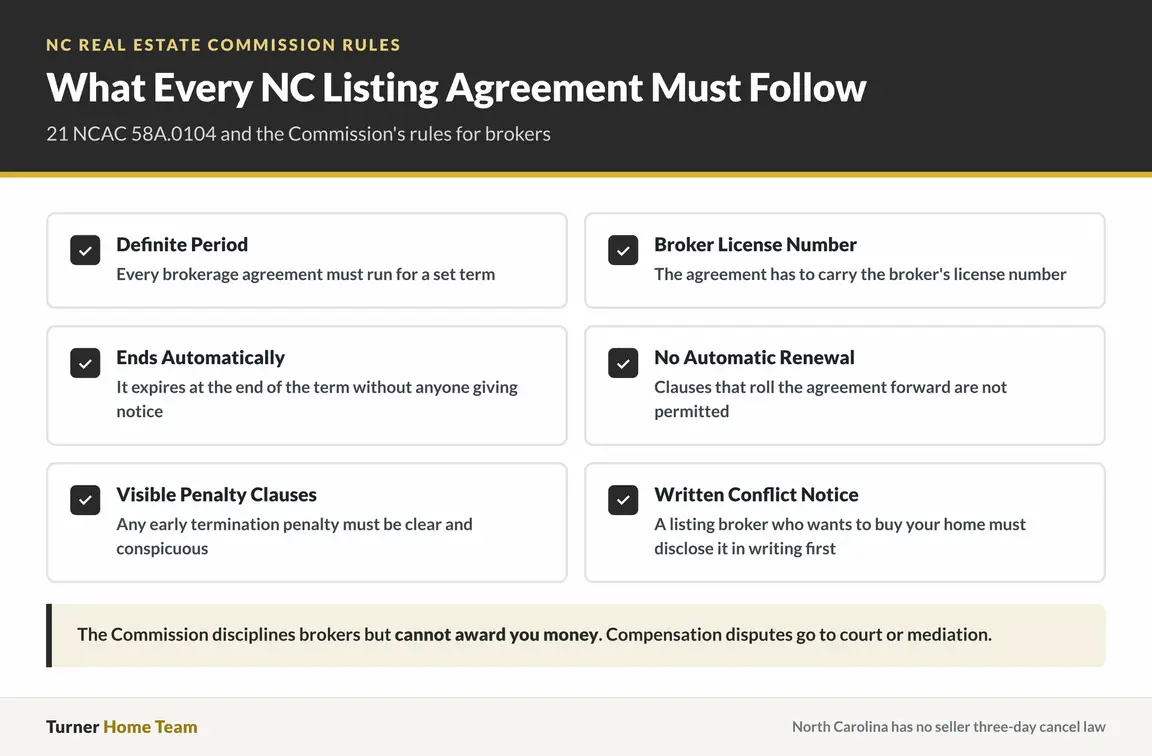
Is there a statewide “three day cancel” law for sellers? No. What North Carolina does have is a rulebook from the Real Estate Commission, and it shapes every one of these agreements written in the state.
Under 21 NCAC 58A.0104, every written agreement for brokerage services has to run for a definite period and carry the broker’s license number. It also has to end automatically when that period closes, without anybody giving notice first. Automatic renewal clauses aren’t permitted. This one rule kills the scenario sellers fear most, where the listing agreement quietly rolls forward forever.
The same rule has teeth on fees. When a brokerage writes an early termination penalty into your agreement, that clause has to appear in clear and conspicuous form, set apart from the text around it, so a seller can spot it. Burying penalty language isn’t clever drafting. It’s a rule violation.
One part works in your favor if your broker ever wants to buy your house. A listing broker or firm that decides to buy a property they already represent has to disclose that conflict to you in writing first. They also have to tell you that you may want independent counsel from an attorney or another licensed broker. Before that broker can sign a contract to buy your home, the firm has to either terminate the listing agreement or assign it to a different broker in the office.
Other events can end a contract outright, including a seller’s death, destruction of the property, title moving by operation of law or a mutual agreement between the two parties.
Who enforces any of this? The Commission licenses and disciplines brokers across North Carolina. Its consumer guide explains that you can file a complaint if you believe you’re not being represented fairly. It can’t award you money, though. Compensation disputes belong in court or in mediation.
Can a Seller Back Out of a Listing Contract Before It Expires?
Standard Form 101, the Exclusive Right to Sell Listing Agreement published by NC REALTORS, says plainly that a seller is hiring the firm as exclusive agent for a defined term. You can withdraw from the agency relationship, but withdrawing from agency and erasing your contractual obligations aren’t the same thing. No other single point trips up more North Carolina sellers.
Think of it like this. Pulling the listing off the MLS stops the marketing. It doesn’t automatically stop the firm’s right to be paid under the terms you signed.
Several situations can open the door early. Your broker may have breached the agreement by failing to perform promised services. The firm’s broker-in-charge may care more about its reputation than about one stale listing. Or the agreement itself may spell out a cancellation path.
Form 101 also carries a protection period. That’s a window after expiration when the firm still earns its fee if you sell to someone it procured. The form requires the firm to deliver a written list of those protected names within 15 days after the expiration date. Without that list, a claim is hard to make stick.
There’s an off switch, too. Under the current form, the protection period stops applying if you sign a valid listing with another real estate broker before agreeing to sell. Sellers who leave one brokerage and hire another in North Carolina generally aren’t exposed to a double commission claim on the same sale.
Leaving on a handshake is where this goes wrong. With nothing in writing, the commission argument shows up the moment an offer does.
How Do You End a Real Estate Listing Agreement Early?
A Winston-Salem seller called her broker on a Tuesday, frustrated after four price cuts. By Friday they’d both signed a release, and she had her property back with no money changing hands.
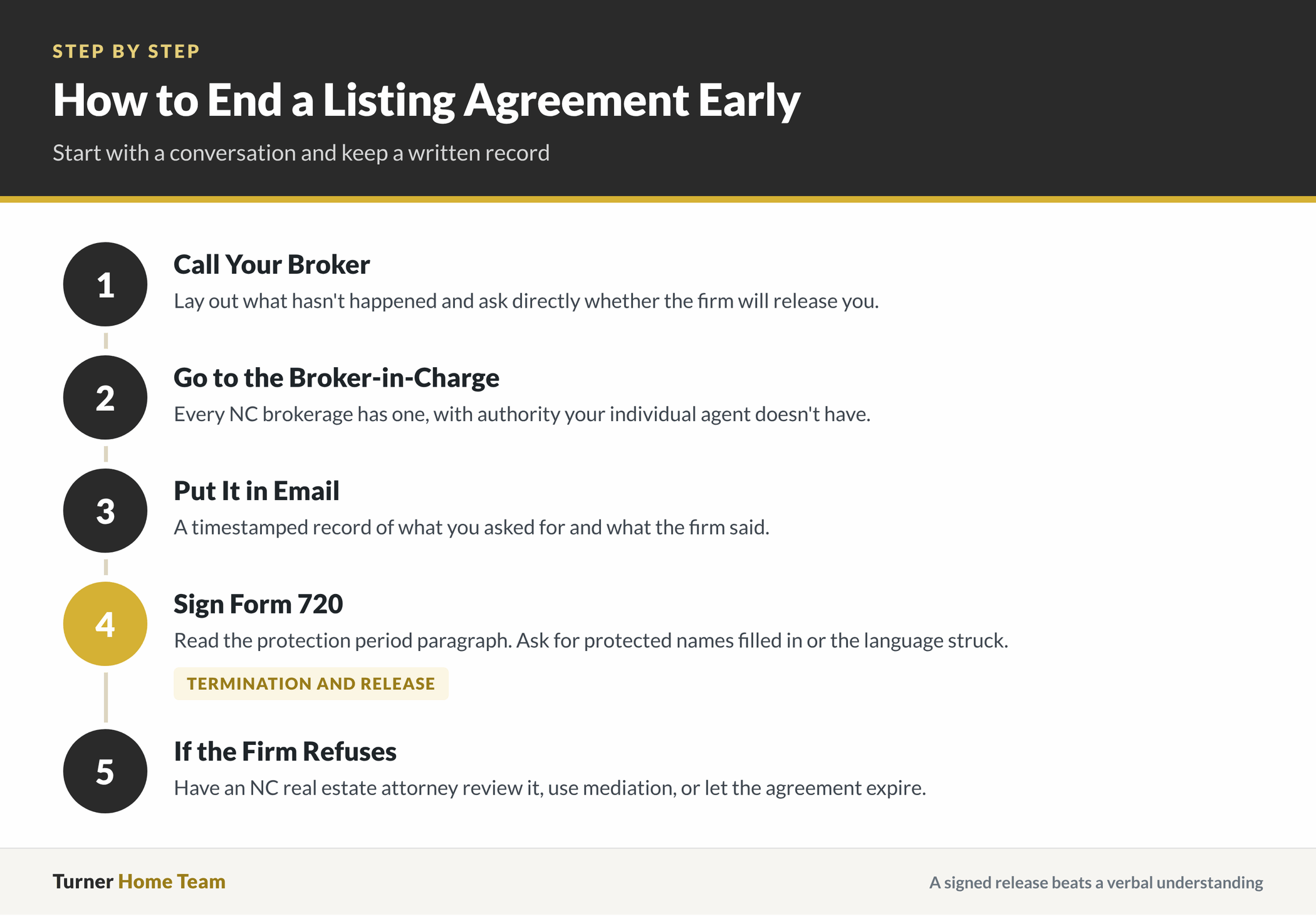
Call your broker, spell out what hasn’t happened, and ask directly whether the firm will release you. Many will. Brokerages that know a listing agreement has gone sour rarely want it cluttering their office numbers.
If that call stalls, go over your agent’s head. Every North Carolina brokerage runs under a broker-in-charge who supervises the firm’s licensees. The broker-in-charge has authority your individual agent doesn’t, and plenty of these disputes die quietly at that desk.
Put your requests in email. It gives you a timestamped record of what you asked for and what the firm said, and you’ll want that record if the two sides later disagree about what was promised.
NC REALTORS publishes a termination form, Standard Form 720, the Termination of Agency Agreement and Release. A revision added language preserving each side’s rights under the protection period for a stated number of days after the termination takes effect. Read that paragraph before you sign. Ask your broker to fill in the blank with the real names of any protected parties, or to strike the protection language entirely as part of the release.
Some firms will name a figure for out-of-pocket marketing costs. Others just tell you to take the release and go.
Should the firm refuse outright and you believe it breached the agreement, a North Carolina real estate attorney can review the document and tell you where you stand. Mediation is another route if both sides agree to it. Letting the agreement expire works too. Waiting out sixty days beats litigating for six months, and an agreement with a near expiration date rarely justifies the legal fees.
Our team at Turner Home Team talks with North Carolina homeowners in exactly this spot all the time, usually after the listing agreement has run its course.
Is There a Fee for Breaking a Listing Agreement with Your Broker?
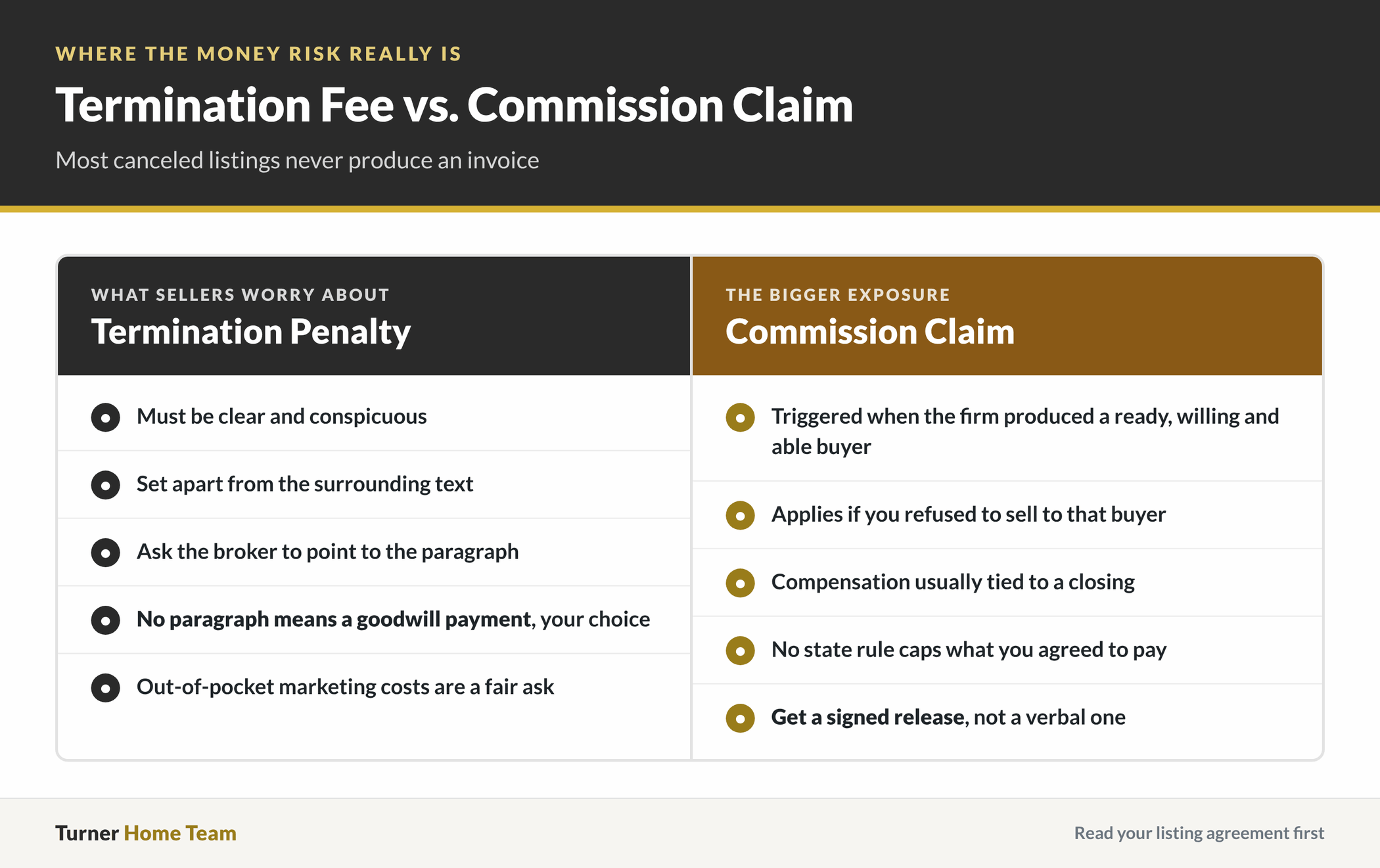
Most of the time, no invoice ever shows up. The typical listing agreement in North Carolina ties the firm’s compensation to a successful closing, not to the signing of paperwork.
One exception is out-of-pocket marketing money the firm already spent. Those costs are real, and a broker who fronted them has a fair ask.
Early termination penalties do exist, but they can’t hide. The clear and conspicuous requirement covered earlier is your first checkpoint. If you can’t find a clause like that standing apart from the rest of the text, odds are good your listing agreement doesn’t have one.
Your bigger financial exposure isn’t a cancellation fee at all. It’s a commission claim, triggered when a firm produced a ready, willing and able buyer and you refused to sell. Sellers tend to overlook it while they worry about a penalty that usually isn’t there.
Whatever you agreed to pay is what the listing agreement obligates you to, and no state rule caps it.
Numbers put the stakes in scale. Wake County’s median sale price was about $459,000 for the three months ending October 2026, per Redfin, with homes averaging 50 days on market. A commission dispute on a house at that price is no small argument. It’s why I push sellers toward a signed release instead of a verbal understanding.
My advice, and some brokers won’t like it: don’t pay a termination fee you can’t locate in the document. Ask the broker to point to the paragraph. If it doesn’t exist, you’re negotiating a goodwill payment, and that’s your choice rather than your obligation.
I’d only make a goodwill payment if the broker truly earned it.
Where Can You Find a Listing Agreement Cancellation Form?
For years I told sellers to just download a generic release online. It was sloppy advice, and it ignored how North Carolina brokerages actually paper these things.
The forms used here come from NC REALTORS and are licensed to member brokerages. Form 720 handles termination and release. Your broker has access to it, and you generally don’t, at least not as a standalone download. It’s by design, not obstruction.
Any broker-in-charge can produce a termination document in minutes.
What should you look at before signing? Start with the effective date, so nobody argues about when the listing agreement stops. Then read the protection period paragraph and the number of days written into it. Check the list of protected buyers, if the firm claims any, and whether the release covers both parties or only the brokerage.
An attorney licensed in North Carolina can draft a release from scratch if your brokerage drags its feet. Real estate attorneys handle closings in this state anyway, so most are fluent in this kind of contract language. I’ve had agents point clients to one when talks stalled. A short review of your original contract plus a custom termination document isn’t expensive legal work.
Say the firm refuses to sign anything and keeps your property listed against your wishes. The Commission takes complaints from consumers, and its Regulatory Affairs Division investigates them. Attach your documentation when you file: the listing agreement, your written requests and the responses you got. Know going in that your complaint becomes a public record shared with the broker, and that the Commission handles discipline, not refunds.
Keep the original listing agreement, every email and the signed release scanned and backed up somewhere easy to find.
One more note on forms: Form 101 refers to a professional services disclosure, which brokers provide at listing. Most sellers skim right past it. Hold onto that disclosure with the rest of your file in case anything goes sideways later.
What Happens If You Sell Your Home Without an Agent After Canceling?
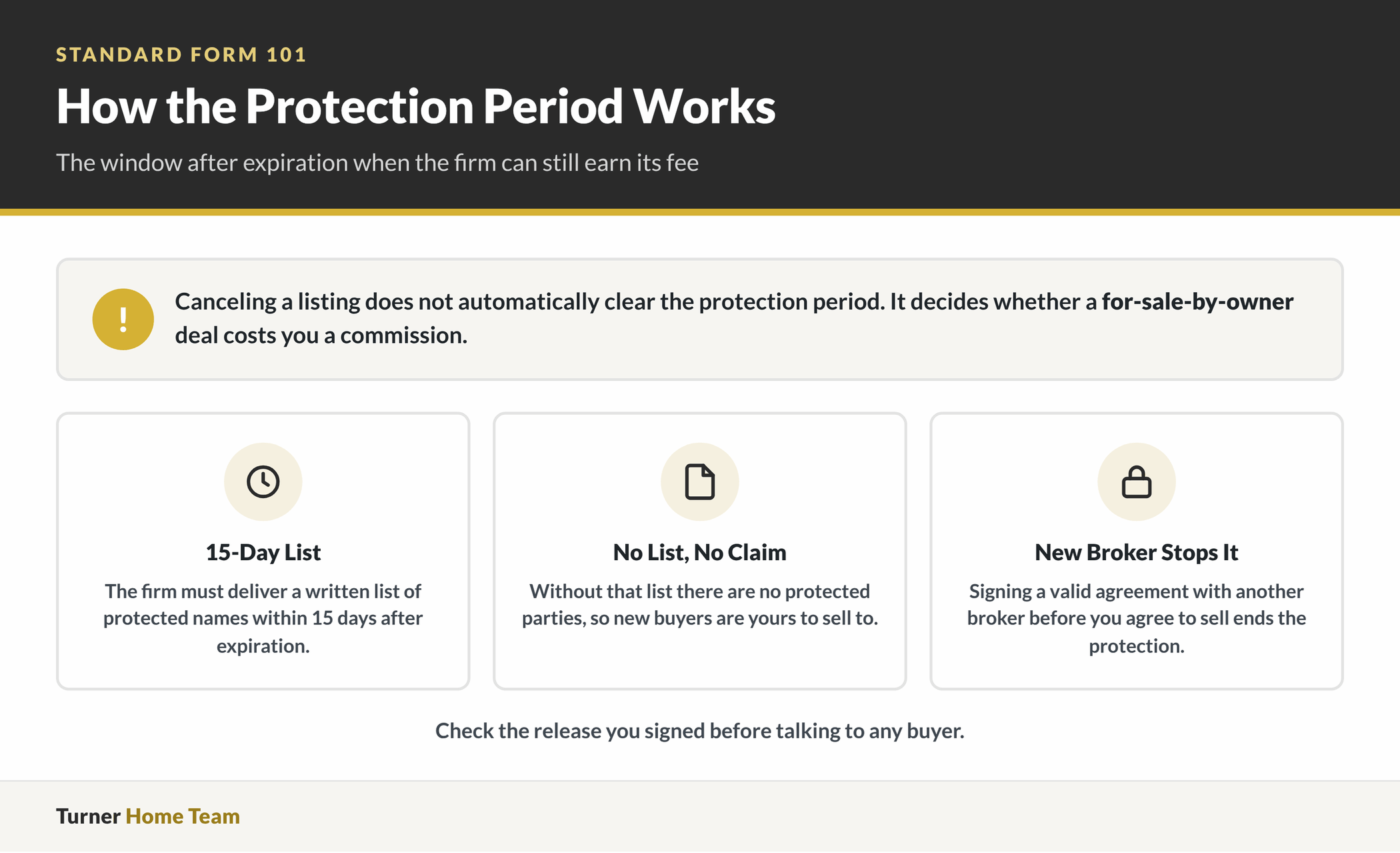
Can you sell on your own and skip the commission altogether? Canceling a listing agreement doesn’t automatically clear the protection period, and that one fact decides whether a for-sale-by-owner sale costs you a commission. Say the buyer who knocks on your door in January toured your house with your former broker back in October. The firm may well have a claim, depending on the release you signed.
No list delivered within that window means no protected parties. Anyone who contacts you fresh is yours to sell to.
Selling without representation in North Carolina means handling residential property disclosures, the offer to purchase and contract, and due diligence negotiations yourself. Repair requests, appraisal problems and the attorney-managed closing land on you as well. A buyer’s mortgage lender can slow you down in ways your old broker never did.
Weigh market conditions in that decision. Durham homes averaged 49 days on market in October 2026 and sold for roughly 2% under list price, Redfin reports, and that’s with professional marketing behind them. For-sale-by-owner listings with less exposure usually take longer, not less.
When you set a price, comparable sales data from a cooperating broker, an appraiser or a local buyer who tracks closings beats guessing from Zillow.
Selling direct to a cash buyer is the other route. You skip the photos, the showings, a second listing agreement and the repair negotiations. In exchange, you give up some price for certainty. Whether that trade makes sense depends on what your time and patience are worth to you.
A landlord up in Hickory came to us mid-divorce, holding a duplex he’d stopped wanting the day the paperwork got filed. The tenants had moved out and the back unit needed a roof. His only real request was that neither he nor his ex had to walk the property again, so we closed on his timeline and he never went back to the house.
If that’s where you are after ending a listing agreement, Turner Home Team buys North Carolina houses as-is and can talk you through whether a direct sale beats relisting.
Frequently Asked Questions
What Can End a Listing Agreement in North Carolina?
Several things do it. The agreed term can run out, the property can sell and close, or you and the firm can sign a mutual release. Destruction of the property, or a party’s death or incapacity, ends it as well. A breach by either side can also end a listing agreement, though breach claims usually need an attorney’s eye before you act on them.
Can My Old Broker Still Collect a Commission After I Cancel?
It depends on the release you signed. If it keeps the protection period alive and the buyer is on the firm’s written list of protected parties, the firm may still have a claim. Without that list, or once you’ve signed a valid agreement with a new broker, that claim usually falls away. Leaving a signed contract with a buyer is a separate question, and our post on backing out as a seller covers it.
Is It Better to Cancel a Listing or Just Withdraw It?
Withdrawal pulls the property off the MLS but leaves your listing agreement alive, so the firm’s rights continue until the expiration date. Cancellation with a signed release ends the relationship outright. Withdrawal fits a pause of a few weeks when you plan to relist with the same broker. Once you’re done with that brokerage, cancel, and push for the signed release every time.
Will Canceling Hurt My Chances with Another Broker?
Not usually. North Carolina brokers see terminated listings all the time, and most will ask what went wrong so they can avoid repeating it. Bring the signed release to your first meeting with a new firm, since any broker worth hiring will want proof the prior listing is closed before writing a new one.
Raleigh-Durham Sellers After a Listing Ends
Triangle sellers have felt the slower pace too. Zillow data through August 2026 showed 58.7% of Raleigh sales closing under list price. That gap is one reason a listing can stall and leave you looking for a way out.
Our page for Raleigh-Durham sellers explains how we buy houses in that area.
We also work with homeowners across North Carolina once a listing agreement is behind them.
Talk Over Your Options Before You Relist
Want a second opinion on your listing agreement or a direct sale? You can reach out to Turner Home Team anytime. There’s no pressure either way, and the form below works too.