
The call came on a Friday afternoon, three weeks before closing. A daughter had just heard from the title company that the document she’d been counting on wouldn’t work. Her mom signed it at a bank branch years back, and it only covered medical decisions. Real estate wasn’t mentioned anywhere, so the sale stopped cold.
Adult children ask me one thing more than anything else: can they sell a parent’s house with a power of attorney? Maybe the house has to pay for care, or the stairs got too risky. That document looks like the natural tool, and a lot of the time it is. Still, the paperwork has to say the right things, and it has to still be alive when you sign.
Can I Sell My Parents’ House with Power of Attorney?
I watched one family in Goldsboro, NC lose four months to this. The son’s paperwork had never been recorded with the county, so he sat waiting on a court hearing. By the time it cleared, the buyer was gone and they’d paid a winter of utilities on an empty ranch house.
So yes, you can sell your parent’s house when the paperwork gives you that authority. The sale usually goes through if the document is valid, still in effect, and clearly authorizes real estate transactions, either broadly or for one specific property. A general financial POA, the kind that lets you pay bills and run a checking account, may say nothing at all about conveying real property.
Title companies make the call here, not you or your agent. Someone there reads the document line by line before insuring the transaction, looking for explicit language about selling, transferring, or mortgaging property. If the title company won’t insure it, the sale won’t close.
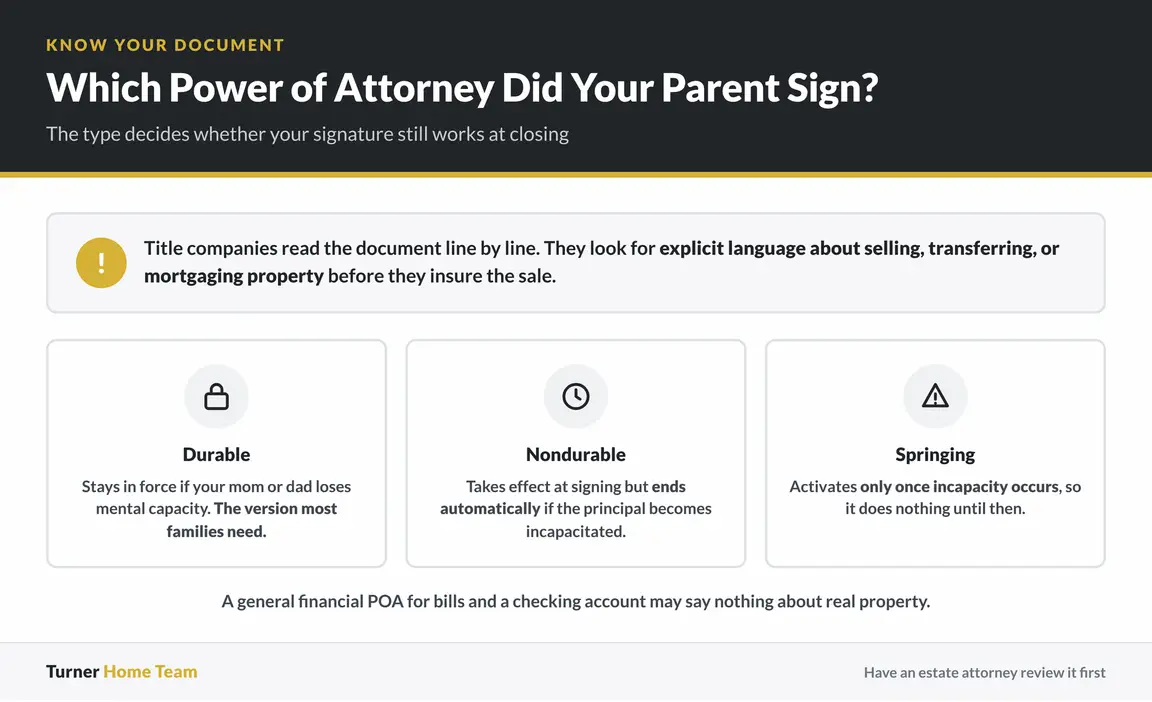
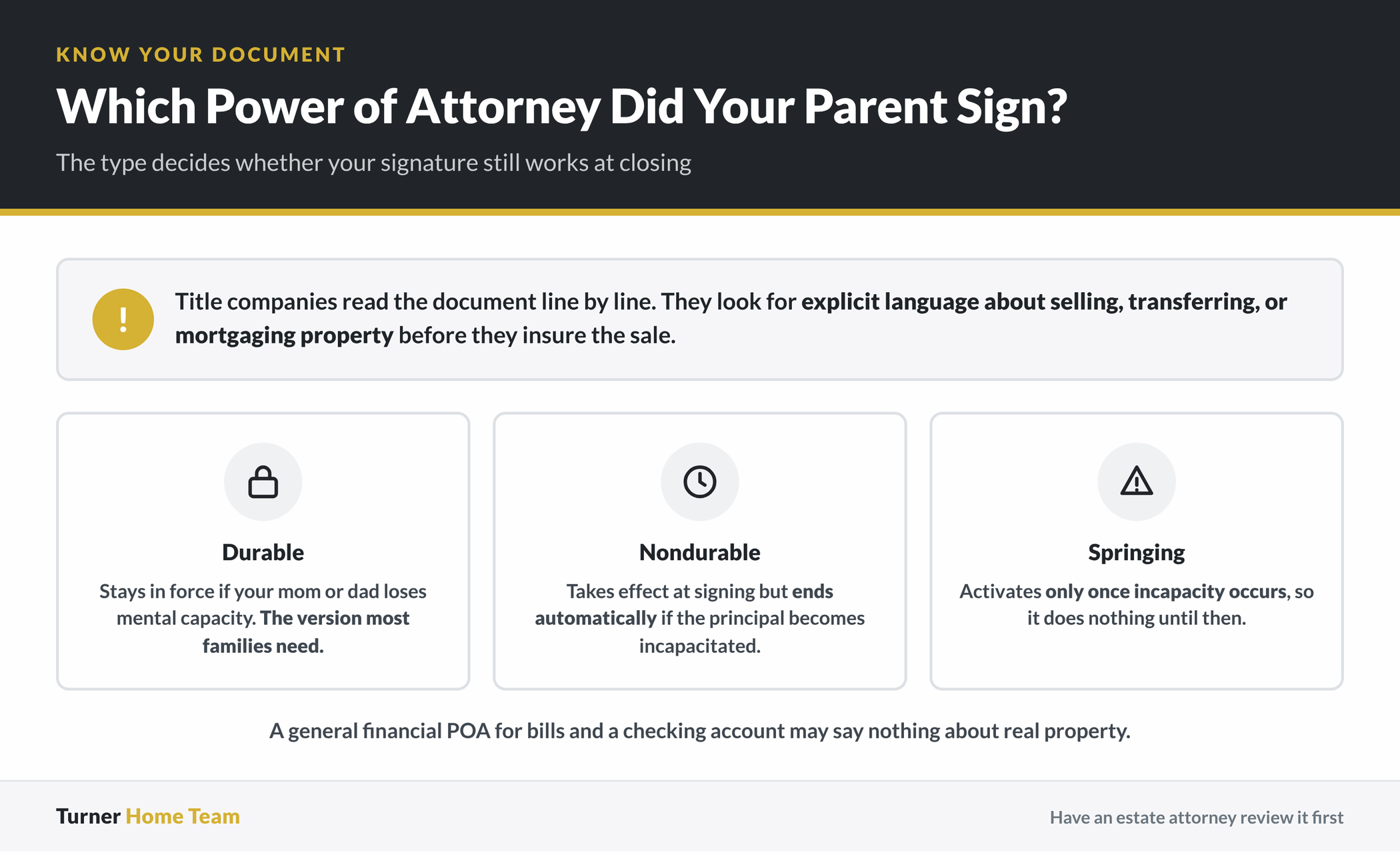
What kind of POA did your parent sign? A durable authorization stays in force if your mom or dad loses mental capacity, and it’s the one most families need. With a nondurable version, authority starts at signing and ends automatically if the principal becomes incapacitated, so any sale after that point would be improper. Springing versions do nothing until incapacity occurs.
Get the document reviewed before you call a REALTOR, not after. I’ve felt that way through years of watching these sales. Thirty minutes with an estate attorney costs less than a month of carrying an empty house, and you’ll walk out knowing if you hold a working key or a souvenir.
Why Families Use Power of Attorney to Sell a Parent’s House
One father I think about lived alone in a four-bedroom colonial and hadn’t climbed to the second floor in two years. After the sale, he was in a one-level apartment near his son, with the medical bills covered.
It usually goes that way. Assisted living costs real money every month, and the house is often the only asset big enough to cover it. Families also lean on this legal document when a parent moves across the country, when dementia makes signing contracts unreliable, or when distance would stall every signature.
The market adds pressure too. U.S. home prices slipped 0.4% year over year in October 2026, to a median sale price of $388,634. When prices drift like that, an empty house loses twice, once to carrying costs and again to value.
Last year a retired couple in Rocky Mount, NC called me after giving their daughter authority and moving closer to the grandkids. Two agent listings had expired back to back without an offer, and the second ended on a Sunday with the sign still in the yard. We bought it as-is a few weeks later, cracked driveway and all. Families in that spot usually want it settled more than they want a perfect number.
Without a power of attorney, the usual fallback is guardianship, and that’s a court process with hearings, a judge, and ongoing reporting. Few families want that. When a parent signs while they still have capacity, the decisions stay at the kitchen table instead of in a courtroom.
What Power of Attorney Lets You Do When Selling Property
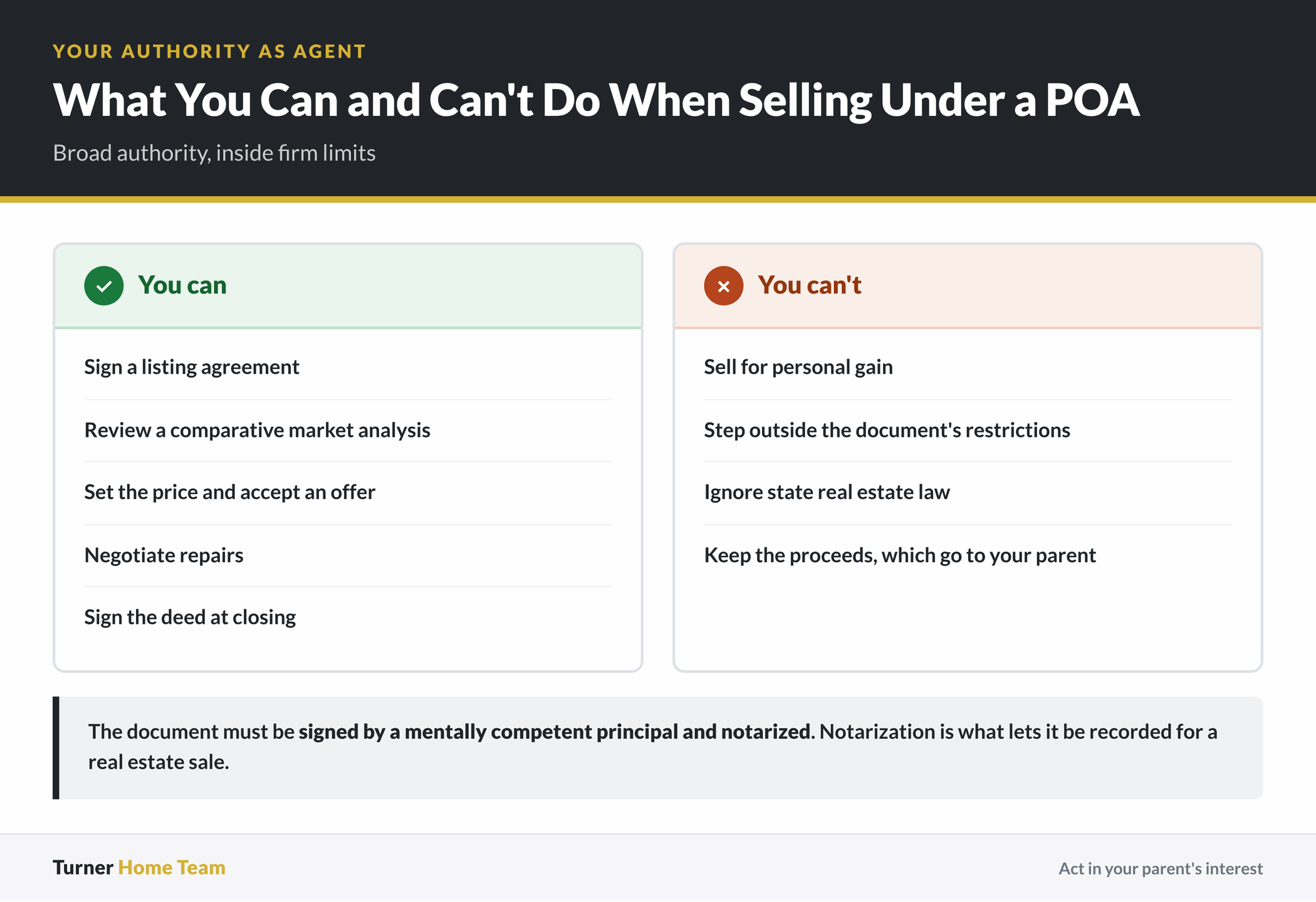
Some agents will tell you the document lets you sign at closing like any other owner. It’s narrower than that. You have to show proper documentation, follow your state’s requirements, and act in the principal’s interest. Selling for personal gain, stepping outside the document’s restrictions, or ignoring state real estate law is off the table.
Inside those limits, you can do a lot. You can sign a listing agreement with a real estate agent and review a comparative market analysis. Setting the price and accepting an offer are yours too, along with negotiating repairs and signing the deed at closing. Cash proceeds go to your parent, not to you.
Two mechanical details decide whether your signature works. The document has to be signed by a mentally competent principal and notarized, since notarization is what lets it be recorded for a real estate sale. Recording comes next. Illinois, for example, requires such a document affecting title to real estate to be recorded in the county where the property sits, with the agent signing in the owner’s name. The deed and recording survey at ezel.ai spells it out.
Each state times that recording its own way. Texas requires a durable power of attorney used in a recordable real property transaction to be filed with the county clerk where the property sits. The deadline is the 30th day after the instrument is filed for recording, per the Texas survey. California goes the other direction: until it’s recorded in that county, the agent’s signature on a deed can be refused.
Your county recorder’s office can tell you what your state expects and in what order.
Does a Power of Attorney End When a Parent Dies?
Early in my career I figured a signed document carried enough weight to finish a sale that was already moving, even if something happened to the owner partway through. I was wrong.
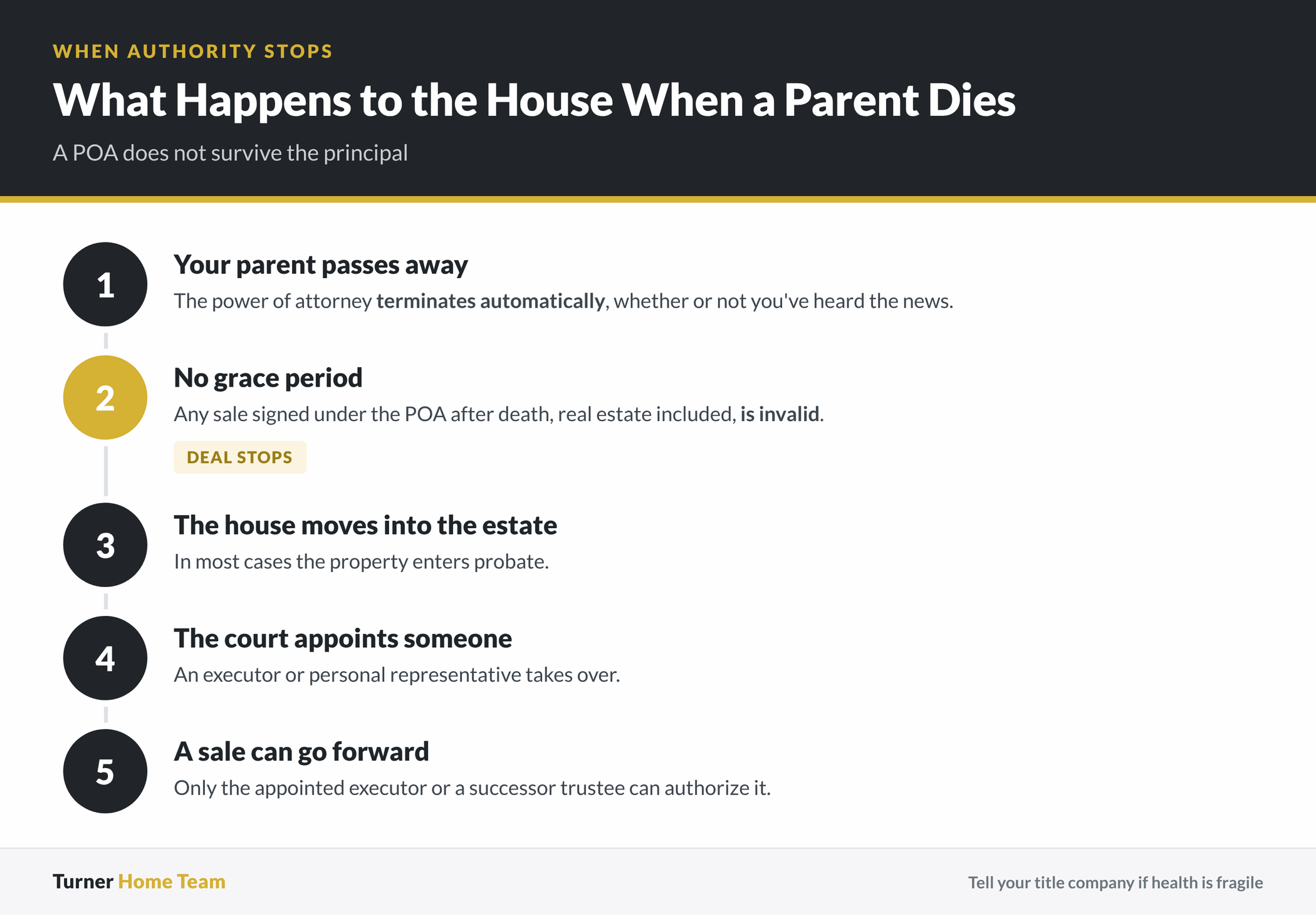
A POA ends automatically when the principal dies. Whatever’s left to do falls to the executor or personal representative named in the will, as FindLaw explains at findlaw.com. The Uniform Power of Attorney Act § 110 says the same thing: the document terminates at the principal’s death.
No grace period exists. Death ends the authority right away, whether or not the agent has heard the news. Any transaction signed under it after the principal’s death, real estate sales included, is invalid.
Say your mother passes on a Tuesday and closing is Thursday, with you scheduled to sign. That sale stops. The house moves into the estate, and whoever the court appoints takes it from there.
States write the same rule into their own laws. North Carolina’s statute says any such document, durable or not, terminates when the principal dies. Florida’s statute ends the authorization when “the principal dies.”
I’ve seen families lose weeks to this. If your parent’s health is fragile and a sale is underway, tell your title company and your attorney now. They can plan the timeline, and sometimes the estate can be opened fast enough to keep the buyer instead of starting over.
What Happens to Property Ownership After Power of Attorney Ends
Once that authority lapses, nobody has the right to sell the house until a court or a trust document names someone.
Most of the time the property goes into the estate and through probate. An executor or personal representative takes over there, and that person has to be appointed before anyone signs a contract. Only the executor the probate court appoints, or a successor trustee, can authorize a sale.
Probate rules and timelines change from state to state. Some estates wrap up in a few months, and others run past a year when heirs disagree or creditors file claims.
Not every house goes that route. Homes in a living trust or held in joint tenancy may pass directly without court involvement. So can a house covered by a recorded transfer on death deed, or one that’s part of a modest estate in certain states. Title to real property can also pass straight to heirs subject to estate administration, usually as tenants in common. Every co-owner has to sign the deed to convey the whole property to a buyer.
This is where siblings get emotional instead of legal. One wants to sell now, another wants to wait for spring, and a third wants to move in. A single holdout among the co-owners can push everyone into a court partition action.
When the family’s split like that, a direct buyer can sometimes break the logjam with a clean closing on a set date that everyone agrees is fair. We’ve handled that at Turner Home Team more times than I can count.
Common Problems That Come Up When Selling Under Power of Attorney
One detail rarely makes it into articles like this: how you physically sign the deed can invalidate it. Illinois directs the agent to sign in this format: the principal’s name, by the agent’s name, as agent. Skip that format and you’ve got exactly the kind of mistake I’ve seen stall a closing. Signing only your own name on the line leaves a title defect someone has to fix later.
Recording references cause their own headaches. A deed signed by an agent often has to cite the book and page, or the instrument number, and the county where the POA was recorded. That matters most when the two documents sit in different counties. Pierce Law walks through it at piercelaw.com.
Older documents make underwriters nervous. A POA signed fifteen years ago can’t show on paper whether it was ever revoked, and your parent can revoke it any time they’re competent. Many closings ask for a recent affidavit from the agent confirming the authority still stands.
Then there’s the clock. Homes spent a median of 35 days on the market in October 2026, up from 33 days in September, according to NAR’s October report coverage. Add six to eight weeks for a financed closing and you’re at roughly three months from listing to funds. For a family paying for memory care out of pocket, that’s a long runway.
Family conflict makes every piece of this harder, and it tends to surface after the sale rather than before. Any sibling who thinks you sold too cheap can challenge the transaction, so keep a record of your decisions: the comparative market analysis, competing offers, and emails.
Other Ways to Sell a Parent’s House Without Power of Attorney
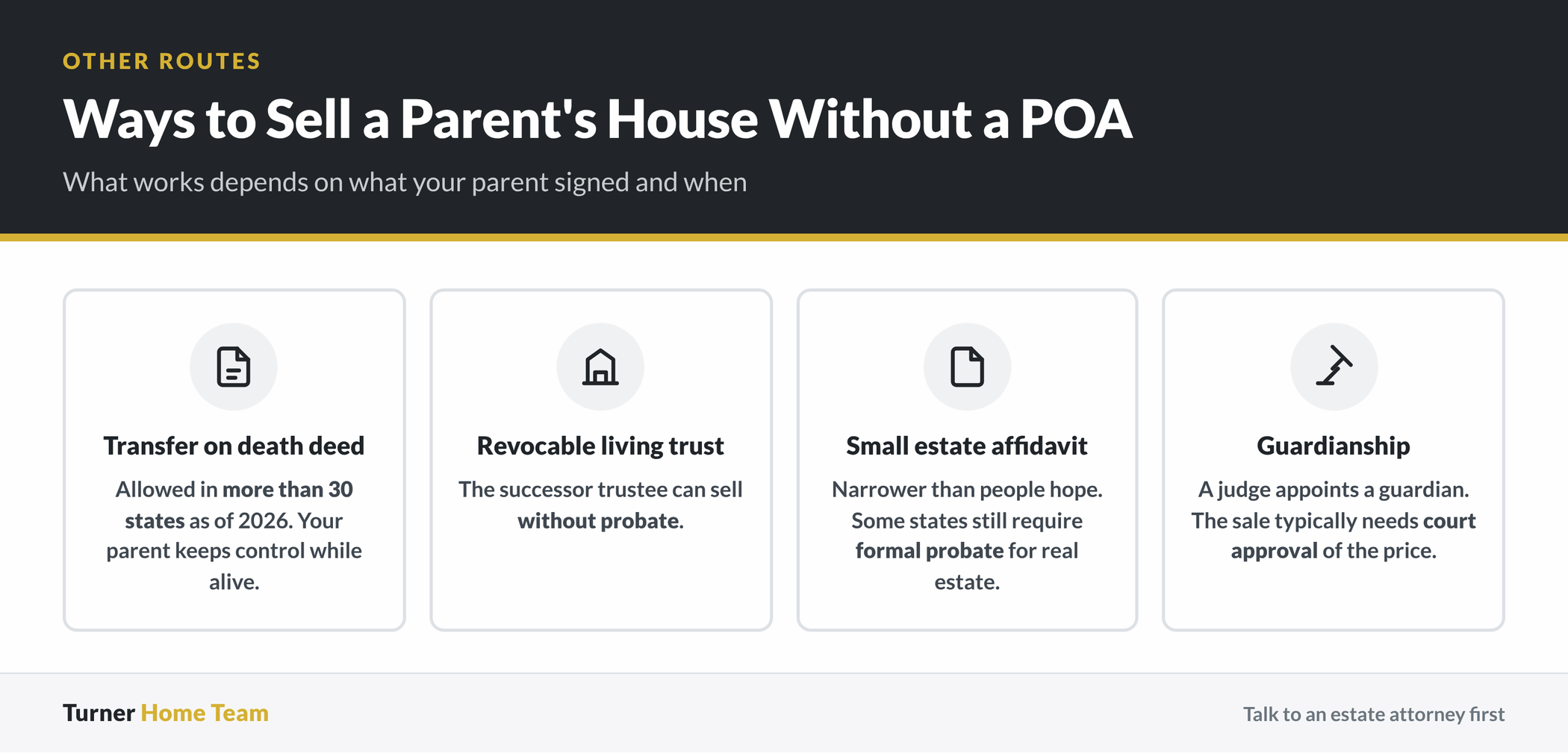
More than 30 states allow transfer on death deeds as of 2026, so one recorded document can keep a house out of court entirely. Your parent keeps full ownership and control while alive and can sell, mortgage, or revoke at any point. At death, the property passes to the named beneficiary. Nolo keeps a state-by-state list at nolo.com.
Revocable living trusts work the same way, with more flexibility. The successor trustee can sell without probate and without needing a power of attorney at all.
Small estate procedures are a third route, though narrower than people hope. Some states allow a small estate affidavit for personal property but still require formal probate for real estate, even at a low value. Texas, for instance, limits its small estate affidavit to transferring a homestead, and only to a surviving spouse or minor child. TexasLawHelp has the specifics.
For a parent who already lacks capacity and never signed anything, guardianship is the fallback. A judge appoints a legal guardian, and the sale typically needs court approval of the price.
In Fayetteville, NC, a landlord inherited his mother’s rental duplex plus thirty years of her belongings piled in the garage, including a disassembled motorcycle nobody could identify. His two sisters wanted out fast, and none of them lived within driving distance. We bought it with everything still inside, and each sister kept one box of photographs.
When the cleanout math doesn’t work, or probate has stalled your timeline, a direct sale to an experienced buyer is a real option. Turner Home Team handles these situations regularly, and finding out what a property is worth as-is costs you nothing.
Frequently Asked Questions
Can an Agent Under a Power of Attorney Sell Property Without the Parent’s Consent?
Your parent gave consent when they signed the document, and that’s where your authority to sell comes from, so you don’t need fresh approval for each decision. As an agent under a power of attorney, you still owe a duty to act in your parent’s best interest, not your own. If your mom or dad still has capacity and opinions about the sale, bring them in. A sharp parent who objects can revoke the document on the spot, and your authority ends right then.
What Are the Warning Signs of Power of Attorney Abuse?
Red flags include an agent who won’t share records, sells a house well below market price, or moves proceeds into an account they personally control. Shifting the property to the agent, the agent’s spouse, or the agent’s child is one of the loudest warnings there is. Other signs are a document signed while the parent was clearly confused, an agent who appeared out of nowhere, or a sale rushed through without any comparable pricing analysis. Any of those deserve a call to an estate attorney or your state’s adult protective services office.
What’s the Best Way to Transfer a House From a Parent to a Child?
It depends on taxes, Medicaid planning, and whether your parent needs the equity, so no single answer fits every family. A living trust or a recorded beneficiary deed usually beats gifting the house outright during life. Inheriting property generally gives the child a stepped-up cost basis, and a lifetime gift doesn’t. Sit down with an estate planning attorney before anyone signs a deed. The meeting costs far less than a tax bill nobody planned for.
Does a Power of Attorney Have to Be Recorded Before I Can List the House?
Listing usually isn’t the problem; signing the deed is. As described above, some states want the document on public record before your signature counts, and others allow recording shortly after the deed is filed. Ask your title company early what it needs to insure the transaction, not the week of closing.
What If My Parent’s Power of Attorney Doesn’t Mention Real Estate at All?
Then it probably won’t work for a sale, and the title company will likely turn it down. If your parent still has mental capacity, the fix is simple. An attorney drafts a new document with explicit property authority, your parent signs it before a notary, and you record it where required. Once capacity is gone, guardianship through the court is usually the path left.
Can I Still Use a Power of Attorney If the House Has a Mortgage on It?
Yes, as long as the document grants real estate authority. The loan is paid off from the sale proceeds at closing like any other transaction, using a payoff statement the lender sends the closing agent. Reverse mortgages add a layer, since they carry their own repayment deadlines tied to the borrower leaving the home, so mention it to your closing attorney right away.
What the North Carolina Market Means for Your Parent’s House
Turner Home Team is based in Greenville, and we buy houses from families in Greenville and the towns nearby. North Carolina’s statewide median sales price was $368,990 in October 2026, with 5.98 months of inventory, according to the NC REALTORS monthly housing report. In a balanced market like that, a house that needs work or sits empty can stay listed for months.
We also work with homeowners across North Carolina who are handling a parent’s house from out of town and can’t be there for showings. If the power of attorney checks out, we can buy the house as-is and close on a date that suits your family.
Get a Straight Answer Before You Sign
Sitting with a stack of documents and no clear sense of whether your parent’s power of attorney lets you sign? You’re not stuck. Start with an estate attorney on the paperwork. For a straight read on what the house is worth as-is and how fast it could close, reach out to us at theturnerhometeam.com. You’ll get an honest answer either way, and if listing with an agent is the better move for your family, we’ll say so. No pressure, no obligation.
When you’re ready, contact Turner Home Team and fill out the short form below.